Monday, October 17, 2022

XP charts

If you have read this blog a little, you'll know that I like minimalism. Not because rules are boring and school sucks, you know. I just like rules when they are meaningful and the cool shit they apport compensates the complexity they demand. 

Lately I've been studying carefully this classic XP charts. 

I was thinking that as the thief progresses much faster than the fighter, he might actually get tougher than him at some point. I made the numbers and, using 1d4 and 1d8 HD respectivelly, the fighter will always tend to have more HP than the thief at the same XP, at around a 3:2 proportion. But that was it: The saves will always be equal or at +/- 1 difference. Same with the attack rate: the thief will attack worse at some levels, but will get higher levels faster so he will attack as good as the fighter during most of their career. So, essentially, the thief just sacrifices a potential 50% increase of HP and proficiency on some weapons and armor in exchange of the thief skills.
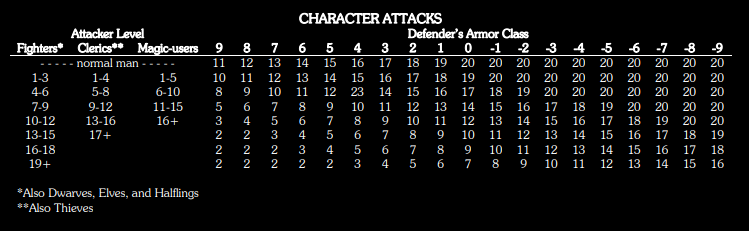


So, if that was the point, it seems unnecesarilly complicated: Writing their own XP chart, assigning a different HD size for each class... Would not be much easier to just say: "This is the universal XP chart for all classes. Fighters get 50% more HP, Thieves get thief skills"?

Well, maybe. Would it be better? again, maybe. Who knows.

The same could be said for the dwarf: In the end he is just the fighter but with MUCH better saves, a skill for discerning shit around dungeons and infravision. In exchange, he cannot use 2h weapons (irrelevant), but gets a small "tax" in  the shape of slightly increased XP requirements (a 10%). This also makes that, though they have the same d8 as fighters, their HP increases a 10% less in the same time on average. Wouldn't have been easier to trash the different chart altogether, alongside HD size differences, and just give the dwarves their pack (weapon restriction, infravision, saves, mining knowledge) and an increased amount of HP respectivelly to the thief standard? just a little bit smaller than the fighter one. Maybe just a bump to constitution: It makes sense in-game and would organically raise the dwarf's average HP.

Again, maybe. 

But the thing is that, even though I have made similar arrangements in my games, I actually like different PCs raising in level at different paces. It makes leveling up a special thing for everybody, just like a birthday party would not be the same if everybody in the world's birthday was the same day. It also feels natural for each race to have different XP milestones. It makes sense for the elf to level up very slowly! 


Still, I cannot help striving for minimalism and if the chance to supplant a chart with a procedure falls in my hands, I must at least consider it. I've had one idea to keep escalated progression amongst PCs while having the same chart for every class. More or less, it is like this:

Everytime you do something that might level you up (like, for example, retrieving 1000 gold pieces), you roll a die (lets say a d6) and sum that number to your XP

You level up at exponentially higher milestones. For example: 6 XP, then 16 XP,  them 40 XP, then 100. This way, you never know if this travel will get you leveled up until you actually bring back the gold or do whatever grants you that experience. Some characters will roll higher, some lower...

Once you have this, it is easy to have this system hacked to do other things: Some treasures or quests having you roll higher or lower dice: "this diamond was worth 1d8 XP. Killing that monster just 1d4". You can adjudicate some XP dice to a given "quest" without problem, with the chance of getting a single XP on a 1, or to get a big roll, which can even get you from level 1 to level 2 straight at the first downtime.

Also it can be used to balance races too: some races might be powerful, but they might have a penalty to leveling up and use 1d4 to do it. It can be the effect of an undead curse, or, converselly, be increased by the power of an item/magic/whatever. 

edit: see this alternate comparison of XP/HP on Spriggan's Den

Thursday, October 6, 2022

Fire Elixir Forever


I ran a long cyberpunk-themed campaign years ago, based on the adventures of a street gang (the PCs) versus another gangs of diverse levels; the most powerful one being a mix of the Yakuza and the OCP from Robocop. The rest of the setting was a wild mixture from Battle Angel Alita, Grand Thief Auto, The Warriors, Streets of Rage, Gungrave, Daredevil and Akira. The game stopped eventually due to two of my friends stopped talking to each other for unrelated reasons.
I used a very simple ruleset I came up with (Very similar to Lasers and Feelings, with "fiction first" style HPs and freeform skills) which had its pros and its cons, but it was very narrative and I didn't like it drove the game towards the players "negotiating" with the GM out of character; and made combats rely on my personal judgement and whims more than in tight rules. This made combats seem unfair on victories (it always felt like I had "given" them the combat) and even more unfair when they lost. I am maybe being so hard with myself: everyone involved were thrilled and we all remembet the campaign very fondly; pieces of it still appear on our day to day conversations and have changed the way we look at our hometown forever (the game was set on an alternate version of it)

Recently I "unwillingly" came up with some rules that I think that would have worked very good, and I want to write them here just in case I need them again. I don't think I will reunite the old gang or continue that campaign where we left it, but some of them are back in town and who knows if I can pull out some sort of spiritual "reboot".

Character Creation: Roll 4d6, then arrange them from highest to lowest. In that order they give you:

1) your age (add 11 to it. If your character is not part of a young gang for some reason, ignore this result)

2) # of starting items. You roll them on a separate table: some of them are actually traits and are inherent to you, while others are physical objects and can be given or traded to other PCs before the game starts.

3) Your starting hit points. Your gang's vest gives you an extra +1 as long as you wear it. 

4) Your # of skills

Skills: 


Kung-fu: This covers all melee or shuriken-based combat, from fists to katanas. 
Gun-fu: guns, guns, guns. I don't think the genre needs more differentiation in combat skills.
Ninjutsu: This is for when you dodge, sneak, jump more than one would thought, etc. It is possible for non-combatants to be skilled in this arts, specially for animals and kids.
Hacking: From John Connor stuff getting easy money to programming the Matrix
Mechanics: Engineering and repair of vehicles, cyberparts, the physical part of robots, etc.
Medicine: From first aid to acupunture to surgery to the implantation of cyberparts. Ido from GUNNM is an example of somebody who knows both medicine and mechanics
Driving: Useful for biker gangs who do a lot of road mayhem.
Charisma: This is not something that magically bends people to your will, but will come up when an NPC makes a reaction roll, when you try to influence a crowd or when you make a proposal to an NPC that is at least feasible to be accepted. This is Harry McDowell from Gungrave or Cyrus from the Warriors.

Notice that there are no void skills like cooking or lore: history. These nine are those that shape the genre I am trying to emulate. However I don't want to limitate the game to them. You can make up any skill you want as long as it doesnt step on the toes of all those listed above. Any kind of specific lore, an incredibly useless profession or hobby, etc. If you want optimization you can do it, if you want to be a flute player you can do it too. We had this rule for years, it worked perfecly and I loved it


Resolution:

You roll 1d6 if its something everyone can attempt. + 1d6 for skill; +1d6 for skill mastery, +1d6for situational bonus (This is called the Special die), up to 4d6

5-6 is a success. 4 is a partial success, and 1-3 is a failure

Combat:

Highest Hp goes first, unless duels and stuff where everyone rolls at the same time. 

You roll 1d6, + 1d6 for skill; +1d6 for skill mastery, +1d6for situational bonus (Special die), up to 4d6

The results are read like this:
1-3: miss
For each 4, you deal 1 damage.
For each 5 or 6, you deal 2 damage if using fists, 3 if using a street weapon and 4 if using a proper weapon.

Armor is rare, and normally pieces of combat cloth, such like a superhero's suit, provide some work as an extra amount of HP.
Real armor is more likely to happen when one has a metal exoskeleton, or a piece of cloth designed to stop a specific weapon (a kevlar vest for example). This kind of armor negates your best result when rolling against it, instead or in addition to HP increase.


Starting Items/Traits: not the definitive version, I am improvising it, but it looks something like this. There are also examples ingrained on how to deal with bonuses and mechanical parts on a system like this. Probably would benefit greatly from improving the table to a 1d36 one.

3 Minor Psychic Powers. Choose 1, the others may be granted to you sometimes at GM's discrection: Telekinesis, Psychometry, Telepathy, Clairvoyance. You can get better at this by investing in a secret skill: Eerieness.
4 1d6 grenades. They deal 1d6 damage on a hit. On a 4, you can but your enemy gets a free move against you. On a miss, you lose turn cant launch them yet.
5. Toolbox. Allows you to repair and custom vehicles, cyborgs and other stuff. Advanced surgery needs you to work in a lab (improve your homebase until you have one). 
6. Bionic implants, choose 1: Hacking Port (counts as a computer), Adamantium bones (+2 HP), Hidden street weapon; Bionic Eye capable of Thermal Vision. 
7. Aesthetic portable computer: Allows for hacking shit. Taking your effort to set multiple computers allows you to roll, and then re-roll the special dice that many number of times.
8. Tiger Kick: When using street or no weapons, you can add the situational die to combat rolls whenever you can use your legs. Once you miss a roll, your attack becomes predictable and you lose this bonus.
9. First Aid Kit. Use a turn & a medicine roll to cure 3 HP on a 5-6. On a 4, the kit is exhausted. On a miss, you also fail to heal anything.
10. Knife, Chain, Nunchucks or Spiked club (street weapons)
11. Apple, Chicken, Soda or Cigarettes. Those kind of shit gives you back 2 HP when consumed.
12. A couple of walkie-talkies
13. You get a light motorbike that allows for 2 passengers. Roll 1d6 to see its max speed (1:low, 6:very high)
14. Gun or Katana (mean weapons)
15. 1d6 doses of your favorite drug. Choose its effect: Hypnotic, Trippy, Stimulant, Chill, Knock-Out...
16. 1d6 Flashbombs and 1d6 shurikens.
17. Panzer Kunst. This martial art helps you to fight enemies twice as high as you or higher. Every time you score a 6 in melee combat, you can roll the "special" dice and add it.
18. Bionic Body specifically adapted to a single skill (+1 special dice per scene/combat)

Leveling up was achieved by surviving X game sessions, and every now and then you earned a new skill or improved an existing one. Now you also get +1 HP. We didn't use HP back then, but a status box (healthy - wounded - dead). In practice didn't work so good.


Lethality. The game is meant to be quite lethal for PCs once you start combating outside the "unarmed" range. You are expendable troops after all, but there are ways to cheat death. 0 or even -1 HP is just incapacitation/dying depending on what caused it; and can still be treated with a medicine kit or similar. But, if you have read enough Battle Angel Alita, you'll know that -2 HP characters that have their head or brain preserved can still come back if a good cyborg mechanic puts them on a new body.
You are also meant to improve your homebase through the game (specific rules to be written another day), and doing so allows you to have new characters start at level 2 or 3, which makes character death a little less painful.

Balance: I don't care shit about balance. You are a gang. All gangs have tough guys and weaklings, skilled and dumb members, who help each other. This is OK. If you get less skills or HP or shitty gear, you can still hang around and interact with the game world. You are not expected to get into mandatory mortal kombat, nor there are pre-planned solutions: attempt things that your character could do. Think how to buy, steal or borrow a solution. Ask NPCs to help you. Whatever. You are not meant to grind the whole setting. There is also a kind of balance in having toughest members fighting while the weak run or do their thing. Ajax and Swan make most of the beatings in The Warriors for a reason. Still, with time you may level up get better at something eventually.

Gameplay procedures: Will expand on this on another entry. I'm taking a lot of time to write this one and I am fucking eager to click publish, so I can chill and take my time with the rest. For now I'm proud with what I got.


Monday, September 12, 2022

Evil cannot create, they can only corrupt and ruin what good forces have invented or made


Evil cannot create anything new, they can only corrupt and ruin what good forces have invented or made - JRR Tolkien.

Apparently people have started using that phrase to critizice the new series: The Rings of Power. Not getting into reviewing the series because I have not seen it, nor have an intention to (despite that, or maybe because, I love Lord of the Rings)

Not only that, but I'm of those who advocate that there are bigger implications on media today that go beyond the theatrical political stances of left and right, and step into social engineery. 

It seems that Tolkien's quote has been so appropiately poignant that ThE pOwErS oF tHe InTeRnEt have spent the last year trying to cover it up as a "falsely attributed opinion" to Tolkien. The Shadow's disinformation pages that call themselves "Fact Checkers" have flooded the net with the undisputed fallacy that it was spread by a "group of astonishingly organized racist persons" annoyed by the appearance of a black elf on the show. 

I know of the title quote for years, and have struggled against it many times by trying to create an RPG magic system that is appropiate for the Middle Earth. You can see some of my latest attempts on this very blog. 

I have also seen the media erase and instaurate truths a lot of times along my life. Every time they get more effective as the hivemind structure of the internet and the social media algorythms make it easier than ever. But as a fan of Tolkien I feel that I must make my humble stand against Wormtongue's lies by making this entry, where, from now on, you can easily check that Tolkien's vision was once recognized as true as it might be: THIS LINK leads to a google search of the quote filtering results from 1990 to 2019, before the series were disclosed to the public. And here you can see a 2016 entry on Quora where a person asks: If evil cannot create things in Tolkien's mythology, how did Melkor create dragons?

Frodo itself makes the best in-setting appreciation of this idiosyncrasy on a conversation with Sam in The Return of The King:

"No, they eat and drink, Sam. The Shadow that bred them can only mock, it cannot make: not real new things of its own. I don't think it gave life to the orcs, it only ruined them and twisted them; and if they are to live at all, they have to live like other living creatures."

Furthermore, evil uncapable of creating must not be seen as a Tolkien's design choice: His work draws its power from the Monomyth (and that is why Lotr and other great works of all ages ring so true and have passed the test of time). It has basis on deeper, magical/spiritual/natural truths that we all know inside, and from which all fantasy, myth and visions emerge. We roleplayers know first hand that necromancers draw their armies from the unwilling corpses of the dead. We who mantain and read blogs know how true gamers create games, rules and worlds in here. Converselly, one would think that Twitter could be a blogspot degradation operated by the Shadow: reducing the character number and the fast propagation it allows not for creating, but encourages fast endorphines through insults, ego wank and mockery. Then, even gaming related accounts end up following the same path of deceit as the common man does: they are eventually lured into a political slot (left or right) and once there, they are presented straw enemies tailored to their hole (bigoted racists for one, retarded feminists for the other) and start fighting a fake war, which in the end only turns them into something they were not at the beggining (bigoted racists and retarded feminists). 

But back to Rings of Power: you can go into the link above and search as many proof as you wish, there is plenty. I don't know how much it will last, though: TV tropes have been forced recently to mark the quote as "badly attributed" and Quora's thread has been recently deleted from most of its tolkien related subs, leaving only that one available. The shadow's agents of pseudotruth are everything but lazy. So, this entry might sound stupid for some, but as both a truth and a Tolkien lover, if the dark wisps try to drown the world in dark lies, what can I do but to light a candle for as much time as I can. 


Thursday, September 8, 2022

Ideas for mass combat (notes)


 I had some ideas today for running mass combat in the frame of rpgs. Never ran one in D&D and im not familiar with all the OSR rules around for that; I only ran one on a homebrew cyberpunk themed game  and it was a real mess. Nonetheless, I had some ideas on how I'd like to do one if I did it now, and I'll put them down here for reference.

First, I'd treat "the big melee" scenario as a zone with random encounters. This table below is an example (1d8). You take +1 if you are some kind of leader, and -1 if you are not an actual fighting man (like a woman or a kid just trying to sneak around a battlefield)

1-2-3: Nobody engages with you this turn. You can help an ally on their encounter, search for an enemy, perform any action, etc

4-5: you face a common troop

6-7: a gang of 1d4 enemies fights you at once

8: You draw the attention of an enemy lieutenant or elite troop.

Then, after all the PCs have done their turn, you check how is the battle going. You roll 2d6 plus modifiers, positive if your side is more numerous or has any advantage, or negative if the other side is. Then use a table similar to this:

12 Enemy is defeated or repelled. This doesn't mean necessarily that all enemies are killed: they might try to surrender, retreat or even make a final phyrric charge for 1 turn; GM will decide.

11 Somewhere an enemy leader has been defeated. +1 on further rolls in this table.

10 Enemy numbers are greatly decreasing. +1 on further rolls in this table.

9: If there is a potential advantage, it is succesfully exploited (enemy lured into a canyon, weak point succesfully applied, etc) and you get +1 on  further rolls on this table. This result might require that the PCs perform a quest first to get the relevant information or setup (GMs discrection). If this result is rolled a second time, it automatically works.

8: You see a known NPC. He rolls a save, on a pass he is fighting, otherwise is dead or unconscious.

7 Battle rages. If you declared that you were searching for something or somebody on the heat of battle, you find it.

6 You see a known PC or NPC wounded or in trouble, asking you for help.

5: Your side is hosed to a disfavorable position or is otherwise forced back. -1 on further rolls in this table. This result can be ignored once if your PCs did any quest to prevent it (GM's discrection)

4: Ally numbers are greatly decreasing. -1 on further rolls in this table.

3 An important leader in your side has been defeated. -1 on further rolls in this table

2 Your side is defeated or repelled

Of course, a battle has more facets than just a big melee. Things like firing from atop of a wall, ambushes, catapults, etc should be handled each on their own way; but succesful and meaningful actions of this type can grant bonuses to the 2d6 roll every battle turn, making them count narrativelly and mathematically at the same time; or even trigger a roll on the table by themselves. Even if thePCs are just watching the battle from atop of a tower, you can use the table to narrate the battle to them by rolling every turn.

Handling big battles this way has the upside that every possible "gamist" aspect counts (character levels, gear, actual battle tactics in the big scale, alongside normal combat tactics, characters dying, characters facing multiple opponents or ganging up on a single enemy, etc) and it makes the battle unfold "from the inside", as if it was seen through the fighting character's eyes; which is the aspect I think that should be highlighted on an RPG as opposed to a wargame where you see battles from an "eagle's view". 

I can see how people might like wargames, and I can see how d&d came from chainmail and such. But in my opinion they are very different concepts and don't mix as well as one might think. Also, in this way, PCs fight using the same combat rules they use in the rest of the game; instead of a simplified or tailored ruleset. 


Wednesday, August 31, 2022

A setting in 4 images

So much time without coming around here! I must take some time to write in here again. Not dedicating myself to rpgs lately, I've become more and more absorbed in that gaming aspect by a local league of Premodern MTG (yeah I know, how could I fell for that?) but now the hype is controlled, I must be back on the tracks. As a warming excercise, I found out about this "trend" of describing a setting in 4 images and wanted to contribute with mine. Not sure on how would I do it, or if it could be done, even. But...


...I'd like to mix Evangelion (complete with angels, epic combat and comfy base-high school parts) with...


...medieval era instead of futuristic age. Not necessarily the "real middle ages" if that is even possible, just some castles, lances and horses. Pic related could be our "Shinji". The picture is called "Portrait of the young knight" and I like to think that it could even exist "in-setting", as a way that they have in Medieval Tokyo-3 to revere their teenage knights and saviors that fight against...


...this terrible monsters that threaten with a very imminent apocalypse that has a parallel relationship with the character's feelings, relationships and discovery of the world, during a seemingly endless unnatural summer. Still not sure on how they should be the only ones to be able to fight in equal conditions with the monsters, or how they are supposed to break their AT fields. The easiest answer is to make them rely on certain magical-special mounts, or some kind of impractical but magical anime swords that only them can wield effectivelly. Choose your favorite:


They also do the important role of adding some neon colors into the picture. Glowing weapons sometimes draw the seriousness out of many settings  (classic shit appearing in mmorpgs) but they kind of fit in here. But I guess that they should be as unique and as important in setting as the Evangelions are for the NERV. For closing, a meme that I just saw and I liked it a lot heheh.


Saturday, April 9, 2022

More art, more insight

Some more art of the upcoming project, for which I don't have a working title yet. I am pondering reusing the one from my half-assed rpg, Monks & Mummies, as it shares muses with it. It also sounds perfect both in english as in my native language (Monjes y Momias!)


But I am considering others that might be more appropiate. Three Lost Treasures, or Los 3 tesoros robados (will post more on the rules once the game is actually printed, hopefully this upcoming month)

These are all the cards present on this prototype at the moment: I made this picture in case I lose the deck or a spare card, so I can remember them all and track which one is missing. They are all done with pencil and color markers, with occassional collages.


Friday, March 25, 2022

Introducing a project: Some art, some thoughts

Parallel to all my rpg heartbreakers, I am finishing a cherished project of mine; this time a small card game with no name yet (just some ideas). It's not mean to be a CCG or a TCG, just a set of cards which compose a "boardgame" all together.
You are suposed to play against a friend both with the same deck; each of you representing some sort of shogun trying to recover their respective heirloom relics from the hands of the other, who has stolen them. Yeah, I know its weird, but it made sense to me eventually.


These are some hand-drawn cards from the beta deck (in spanish). One of my design goals for them is to have the card text as short as possible. I realized shortly that I was writing too much text on them, trying to cover every possible legal trapping: due to my long relationship with MTG, I was using the same prose and mentality.
Though it as hard as it is hard for a man not to carry his homeland's accent, I am trying to get rid of the corporate game-designer vices. There is a reason for MTG to be extremelly careful on their wordings: they got the DCI, grand prixes, etc. They cannot afford a card to have an ambiguous meaning. If, for example, a card is a merfolk, you cannot just name it Merfolk Assassin and have a merfolk on the picture: You must specify Creature - Merfolk on the type line, or cards that affect merfolks won't have effect on him.

But I want to revel in the advantage I have over that kind of game. 
This is a small game meant to be played by persons. Probably persons who are friends or family with each other. I want to believe that if an hypotetical card affects "all creatures who carry a sword" they can civilly discern it by watching the pictures. 
I have this card called "Marsh Frogs", which originally were to have a bonus against spiders. Then I thought on writing "If the marsh frogs combat against the spider, they will automatically win the combat". But then I went: What the fuck, this is not a game for bots. People will understand this. Maybe it will change over time, but the current text is: "They will eat spiders directy". I think that people will surely interpret it the right way, and even if it is not the case, I think that the pleasure of working with human language instead of lawyer language still is worth the risk.