Today, in the "whats hot in rpgs today" section of our program, I present you a small review on two games that are 40 and 30 years old respectivelly.
I was reading
this blog the other day, and I remembered the days of my highschool in which ICE's Rolemaster and Middle Earth Roleplaying was what the cool guys were playing. Not a trace of D&D back then. I even bought the book eventually, but never managed to actually run it because I was probably busy worrying about lots of other stuff. One of my friends at the time "borrowed it" for a time (20 years and counting). But I achieved to learn the game between classes from the cool guys, and eventually I made my first character: a human bard that I imagined like this:
I remember that the session featured skeletons, a riddle for crossing a bridge, being thrown in the cell of a coliseum and managing to get out by enchanting the guard with my only spell (some sort of confusion or sleep, can't remember). I was fucking excited with how awesome it had been.
One thing that the game did very differently than D&D is the nature and importance of critical hits. Basically on combat you rolled your percentile dice, and there was a "VS armor" table telling you how much HP you dealt to your enemy, and wether you scored a big critical, a small critical or none at all. If you did, you rolled on a secondary table that had tiny descriptions in small letters of what happened descriptivelly; depending on the weapon used and the armor they wore. Some of them narrativelly killed your foe instantly (or your character) no matter their remaining HP
For example, rolling a 40 in the crush criticals table (for example by using a mace or falling into a pit) gives you "blow to forearm, +5 hits. If no arm armor, stunned for one round". Rollng a 110 on the slash critical table is "Impaled in heart. Dies instantly. Heart destroyed. 25% chance your weapon is stuck in foe 3 rounds" On retrospective, I think that this tables made combat a lot of fun, helped with the combat narrative and made use of otherwise aesthetic things (suddently, having your character wear arm armor was important, even if for a marginal case)
Magic and Unarmed attacks had their own tables too. When the setting "monk" equivalents got some levels they got to roll in the "big creatures" critical table, which was the one the balrogs used, instead of raising their chance to hit.
shit quality, but you get the idea
Unlike D&D, it is not centered on stealing loot or delving into dungeons, but still uses advancement through XP. Which is very interesting because I'm always trying to run away from XP=Gold for some reason or the other. MERP awards experience in eight ways, some of them worth a thought:
1. HP loss. Every HP you lose translates to 1 XP
2. Criticals. Every critical you deal has a value in XP. The most interesting is that you get double that amount when somebody deals a critical to you. This means that theoretically you and a friend could level up ad infinitum dealing criticals to each other in a dirty alleyway.
3. Kill points. Depending on your level and the monster's level, you get an amount of XP after dealing the killing blow
4. Maneuver points. When you overcome the classic "roll vs a TN" challenge, you get XP depending on the challenge difficulty (picking locks, convincing guards, all that classic shit)
5. Spell points. You get XP = 100 - (10 x Caster level) + (10 x Spell level) when casting in combat.
6. Idea points. Basically give a random amount to somebody who had an idea to overcome something.
7. Travel points. 1 XP for each mile on an unfamiliar area. Half in civilized areas, x2 or x3 in dangerous areas, and divided by 10 if flying or sailing.
8. Miscellaneous. As long as XP is pre-assigned to specific goals, and not used as "I give you XP for that cool thing you did before" it seems to me like an idea that I find underused on the OSR. The book sadly seems to encourage the latter.
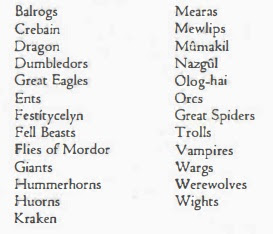
To finish my review, I'd like to say that the book works as Race and Class, and now I realize its heavy parallel to D&D (the 6 stats under other names, using levels, saving throws, etc). It has a LOT of subraces, some of them I don't remember at all being in LOTR (Where do the woses appear in the movie? WTF is a dorwinadan?) and has a nice bestiary:
(WTF is a Dumbledor? wasn't he from another franchise altogether?)
Searching for the old MERP manual, I've managed to find their publisher's second attempt at Lord of the Rings rpg, called simply "Lord of the Rings Boardgame", dating from 1991. And of this one I want to talk a little more, because from the design point of view, it feels very tempting to use, to learn from and to modify.
While MERP (1982) is percentile based, ICE's Lotr (1991) is entirelly 2d6 based. It is much more basic than its older counterpart, which can be bad or good sometimes. But from the "design" point of view, there are some points that caught my attention.
There are 12 skills:
1. Strength
2. Agility (balance and nimbleness, also initiative)
3. Intelligence
4. Movement (Speed, MV per turn)
5. Defense (adds to armor)
6. Melee Bonus
7. Ranged Bonus
8. General (covers climbing, riding, etc)
9. Subterfuge (thief checks. Too many dexterity divisions, or its just me?)
10. Perception (do I see the trap?)
11. Magical (you get 2 spells per bonus, also adds to the casting roll)
12. Endurance (your HP).
skills from 1 to 11 can be as high as +3, and as low as -2
skills from 6 to 11 are "bought". You get +5 bonus to divide between them, but any skill that is not raised gets a -2 instead. I like that this makes a great gap between casters and non casters, fighters and non-fighters, or sneaky hobbits and clumsy human. I would go even further and make it so the first +1 only applies to a favored weapon, which is more in line with the original books (Legolas=bow, hobbits=slings, for example) but using another of the same type (ranged/melee) only drops you to 0, not to -2
skills from 1 to 5 and Endurance depend entirelly on your "class"
There are nine "race and class" packages that you can choose. They all come in a pregen sheet with weapons, equipment and certain skills raised or lowered. The classes and examples it cites are:
Hobbit Scout (Bilbo, Frodo)
Elf Scout (Legolas)
Human Warrior (Eowyn, Boromir)
Dwarf Warrior (Gimli, Thorin)
Elf Warrior (Glorfindel)
Human Ranger (Aragorn)
Half-Elf Ranger (Elrond)
Human Bard (Gandalf)
Elf Bard (Galadriel, Arwen)
I love how the wizard word is totally out of the question. Wizards in this game are treated as bards. The spell list is kind of short, there are like 20 spells with the classic ones (sleep, fireball, identify shit, etc). Anybody can cast spells providing they raise their "magical" skill, so classes are little more than archetypes that help players to get into the character.
Combat is done in a grid, with movement, attack and half attacks. Depending on the action you take (spells go first) you act in a given order, with same actions acting in order of agility. Attack rolls use a small table modified by offense/defense of those involved, with the high results resulting in straight leaving your opponent unconscious (a natural 12 always does, at least, knock out your opponent) or maybe even killing them. Armor adds to your Defense bonus and substracts from subterfuge, magic and movement.
Too basic when compared with the MERP one, maybe. I see the simplicity of the 2d6 as a great excuse for complicating it using the critical tables of the original one!
Strength doesn't affect combat in anyway, which is plainly stupid in a game that uses it as a factor. Seeing that weapons are differenciated by modifying damage done, but with two handers and unarmed combat having penalties to hit, I think that a good way to fix this is to have Strenght offset those penalties by a proportional amount.
The resting 8 of the 28 pages ruleset is dedicated to an oddly specific set of questions. My copy is in spanish, but I found a screenshot that will speak better than my words:
The choice of 14 situations that are thoroughly covered by the rules is very interesting, it says a lot about the challenges that the PCs are supposed to face and about the world they tread on. In which other fantasy game did you see a page dedicated to SNEAKING THROUGH TOWN BY NIGHT?
None of the books have anything such as "procedural challenge generation" or anything that
drives the game forward other than the GM's work, but LOR makes up for it as it was originally printed in a book alongside a module (bigger in pagecount than the actual game), so you could say that the first module was part of the game itself.
(Skimming through it it seems that it features at least Gandalf and Merry as NPCs, as well as a couple of Stone Trolls)
It is cool to know that if somebody decides to play it after all this years, after lots of iterations and games on the Middle Earth that have been published, s/he can find some help with My_GaMe_FiXeS in this small corner of the blogosphere. Nice coming into spring for everybody.
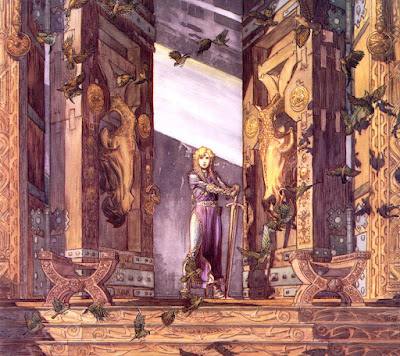
Eowen at the doors of Meduseld