Showing posts with label XP for gold. Show all posts

Wednesday, October 23, 2024

XP = milestones, for classic fantasy

I have an ongoing game, with most PCs at level 4 and some scratching the fifth; but I'm already thinking on a second set of rules... I'm an infidel gamer. It's probably too late to implement XP per milestones instead of gold and monsters, but here it is for posterity. Based on my untested idea for Monks & Mummies. The concept is that whenever a session ends, players check if they have done any of this list (GM as arbiter) and if they do, they can cross out ONE of them (if they did two or more, they must choose one).

[_] [_] I have helped an NPC with his first world problem

[_] [_] I've passed a master's test and enduring his training

[_] [_] I've found some treasure that is beyond mere gold

[_] [_] I've bested somebody in an honorable duel

[_] [_] I've fought an infernal beast

[_] [_] I've solved a mystery

[_] [_] I've stood for my beliefs even when it was risky to do so

[_] [_] I've kept the honor of my liege/master/dojo

[_] [_] I've taught my skills to others.

[_] [_] I've righted a wrong the best I could

[_] [_] I've performed a profession to make a great work

[_] [_] I've retrieved a big treasure

[_] [_] I've been commited to a holy quest

[_] [_] I've fulfilled a holy quest

[_] [_] I've kept a promise

[_] [_] I've atoned for a past misdeed

[_] [_] I've ventured where the world gets weird and came back alive


[_] [_] _______________ (to be decided by the player. I will as a GM make it worth the level it implies)

As you see, every box can be filled twice, but no more; so you can't bank into helping NPCs forever or retrieving treasure. Also, when you tick one of them, also tick a box here:

[x] 1   [_] 2    [_] [_] 3   [_] [_] 4
[_] [_] 5  [_] [_] [_] 6
[_] [_] [_] 7
[_] [_] [_] 8
[_] [_] [_] 9

After you tick all the boxes of a given level, you get that level.

As for the motive, I want to encourage all those things happening in game; but with a big array of options so they are not pigeonholed into doing a specific one. All of them are traps that encourage PCs to search for trouble and do risky shit on their own. I am moving a lot outside dungeons now, with tons of town play, and right now I feel bad having the players choose between the roleplay they love and the XP they crave. The milestones are meant to be interpretable to a loose degree, but not too much.
This method incidentally goes well with my obsession with introducing knightly characters and quests; and some of the clauses can be used to roleplay knightly prowesses. Note that commiting to a holy quest (and its up to the GM what counts as one) gives you a box straight away. The downside is that I will treat it as a "Quest/Geas" spell with penalties if you try to scam your questgiver. Also, finding a giver of a holy quest can be a little more difficult of what one thinks a priori.


Willem and Jan Dermoyen, after Bernard van Orley: Battle of Pavia

Thursday, February 15, 2024

Slot Machine Level Up

The new level up method I am testing right now in this new campaign (We had only one session for now, so there is no feedback yet). Found in my old notes, probably inspired by this post. I call it the slot machine level up.


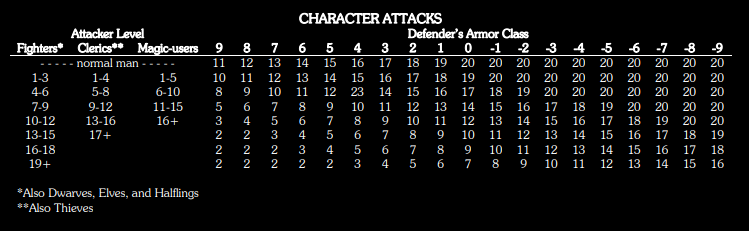
Instead of having your classic charts (for example the fighter's one above) I cut the requirements approximately into a third, rounding down to compensate the fact that I don't use prime requirement reductions.

level 1: 0
level 2: 600
level 3: 1200
level 4: 2500
level 5: 5000
level 6: 10000
level 7: 20000
level 8: 40000
level 9: 80000
level 10: 120000
level 11: 160000
level 12: 200000
level 13: 240000
level 14: 280000

Once a PC goes back to town with XP enough to get a new level, they do a training roll: a 2 in 6 chance to level up. No matter if you fail or pass, your XP amount is set to 0 after the roll.
This, in my humble mathematical knowledge, gives PCs stastically the same advantage rate as in the original (1 in 3 chance, with one third of the XP), but has a handful of things I like:

- Making uneven advancement for different PCs, because I like when there are PCs of different levels on a party as it makes for interesting hierarchy dynamics.

- Random payoffs have an addictive component. The feeling of "maybe I could level up at the end of this session" is something I think is cool.

- The amount of XP you have to track is small as it restarts from zero every time you level up. This has not any advantage beyond the psychological sensation of not tracking a big amount of numbers, but psychological shit is important. We live on the mind after all.


Thursday, May 4, 2023

On Rules-lite or Rules light


stephanie grunwald - drive by night


After reading both Prince and Noisms take on rules-lite games, I wanted to write my own article on the subject. To make it clearer, I won't adress their points in here, I already did on their comments, suffice to say that while I enjoyed their reading, my point of view is tangential. 

I have collected tons of One-Page rpgs, starting back in 2012. I don't like all of them, of course, but as a design fanatic, I often like how they have resolved a certain mechanic (like alignment in Jung Guns), or how they have evoked a certain feeeling with a paragraph or a layout (Raygun Gothic, Travel Journal of Short Tales). It is true that they are often highly unplayable.

As Prince attests, many of them fall back on D&D to cover their gaps. Many more are innocent attempts at fixing D&D forever or just novel ideas that sound awesome in the author's head but have no sense on the page, and much less on the table (I love those. I have made a bunch of those too). Others (more and more everytime) are just made to look nice, with little care of the actual rules, probably because their author doesn't even think on playing it.

As I see it, the problem with rules-light games is not about they having little space or little rules. The problem is that they usually cut off the wrong rules

As I pointed out on previous articles, the core rules of a game are those that create and push the game's biorhythm, as opposed to its conflict resolution rules

The core rules of D&D are XP for gold, the dungeon generation rules that create rooms with gold alongside rooms with monsters, monsters and gold, dangers and traps, and the "level up" boon-unlocking dynamic for characters and dungeons. You play to level up, and adventure happens in the process. Using a d20 to hit or 2d6 vs an adjusted TN can have interesting effects, but won't change the game's nature in the slightest bit. 

Most published games, even rules-heavy ones, don't even have core rules. They just have conflict resolution rules. And that is frustrating because that is not gameable. They have lore bricks instead, and you must make a mission-based game with whatever you can assemble from it. Rules-light games often go the same road, working on innovative, clean or personal resolution rules (usually chargen+combat+equipment) and vague or absent procedures to conduct the game.

No, Maze Rats tables may be a great oracle, but are not a game procedure. It does have rough guidelines, though, on how do dungeons, cities and wildernesses look, and at least mentions the use of wandering monsters. But having XP per session + extra XP for abstractly overcoming a difficult challenge, the game can or cannot feature dungeons or loot of any kind. In fact the game can be about anything. Which seems liberating yet also kind of aimless: players must set their own drives, in a world they don't really know yet. But I am sure it works in the end.

Knave doesn't even have that. I think it was maybe conceived as an alternate chargen/combat/spells for D&D and was considered a full game by some at some point. In any case, OSR-related games have an advantage: the more a game gets closer to the OSR purity, the better it can use its resources: falling back on D&D to fill the gaps or using published modules. I think Searchers of the Unknown was built for the latter in mind too. 

But it would be unfair to accuse rules-light games of this sin, when big games do commit it constantly. Lamentations of the Flame Princess, for example, is written in two big tomes (player guide and referee guide) and somehow forgets to fit any setting, a bestiary, procedures for generating monsters, dungeons, adventure sites or adventure of any kind. It offers some advice on the tone the author wants to convey, but the advice feels short and falls on a void. 

World of Dungeons: Turbo Breakers, being three pages long, achieves to include useful gameable setting elements (the rifts, a countdown to the Cloud of Woe, an archmage called Kai Shira Kai, a Bestiary and a guide to create monsters, etc). 

Into the Odd: One page version, on a single page, allows you to run a dungeon without any preparation, filled with monsters, social encounters and traps; and teaches you to make a similar one by altering the tables therein. If you put simple advancement rules (maybe +1 to an attribute if you roll over it, and +1 to hp for each dungeon completed) and you have enough depth to make a long campaign using that rules alone. 

And as a word of advice: for people who has already read some Lovecraft enough to be familiar with the setting, will find the same or more useful stuff in the 4-page Cthulhu Dark and its companions than in the classic Chaosium tomes, all ripe with an astounding amount of nothing. You will still have to come up with an adventure yourself, but at least you will save time and effort.

So yes, rules light doesnt have to mean depth-light. I actually think they are a good paradigm for designers to learn and test things: the shorter a game is to write, the faster you can test it and re-shape it as needed. Minimalism has no inherent value on itself, but there is a limit on how complex you can make a ruleset without it becoming unwieldy. As I like to see it: the more minimal your rules are in one aspect, the more you can complicate the game in another. For example, getting some minimal rules for combat allows me to make extensive and fussy rules for handling horses without overloading players with information. This way you can add simplicity and complexity to things depending on how you want to portray them on the game you have in mind. 

Recently I put down the advancement rules for Monks and Mummies, one of my many chimeras. I found out that it was actually the hardest part of the game to come up with, and possibly the most important. Now that I know what the game is about, I think I can put the rest together """easily""". The rest of the game is sort of falling into place by itself. And thinking about this ruleslite things this days I have realized that it might not fit in one page, but I can see all the concept fitting on four or five. Let's see. 


Thursday, April 27, 2023

How I do Treasure Types


This is the B/X table for generating monster treasure. I assume that Gygax intended to use it when you are generating dungeons, at home, chilling alone with a cup of tea: It has a ton of rolls to do. Some of them are even PERCENTILE. 

I found myself having to generate treasure a lot of times during the game. Also I strongly dislike having so many types of coin: I only use silver (the standard) and gold coins (armor and other specific things are still keeping their gold prices). Copper is a nuisance and electrum can go fuck itself. I don't even want to know what the fuck it is, but it is surely something I don't want everywhere around on my fantasy world. 

I spent a lot of time calculating the averages of each treasure type. Someday I found out casually that they were already calculated for me, right at the preceding page:


To give it a little randomization, multiply the result according to this table. Note that I use silver standard, so that is the value in silver for me.

1 - 25% treasure
2 - 50% treasure
3 - 75 % treasure
4 - 100 % treasure
5 - 150% treasure
6 - 200% treasure

The numbers add to 600%, divided by six results so its 100%. This means that stastically the treasure amount doesn't change.

Then I roll 1d6 in this other table: The treasure is composed mostly of..:

1 - Gold coins (value as 10 silver coin each)
2 - Gems and jewelry. Depending on my mood this can be a single jewel or a myriad of small gems
3 - Valuable but small items (books, weapons)
4 - Valuable but bulky items (armor, statues, art)
5 - Silver coins
6 - Silver coins

For bigger treasures I divide the treasure into 2, 3 or 4 roughly equal parts and roll separately for each part.

Magical items are rolled normally but I approximate the results with d6. Not because I cannot roll percentile, but is a question of principles (for example, a Type A treasure with a 30% chance of magic treasure becomes 33% chance: 2 in 6). Percentile rolls feel ugly in D&D and the exact numbers are arbitrary after all.

EDIT: for convenience, I also calculated the averages of unguarded treasure rooms per dungeon level:

level 1: 158 gp

level 2 or 3: 483 gp

level 4 or 5: 1553 gp

level 6 or 7: 3205 gp

level 8+: 6256 gp

Average value of 1 gem: 194 gp 

Average value of 1 jewel: 1050gp


Friday, March 31, 2023

Monks and Mummies: Advancement. v2

As the game begins, players are given a communal sheet with some questions and some milestones. 


This set of questions can be answered at anytime to turn a failed roll into a max result. The answer must relate to the problem you are facing somehow; and can be spent to change the roll of an ally too, if the question allows it. Example: "What was that important lesson you received from your master?" can be used for yourself or for any other PC if you are willing to consider him a master, or if you yell that lesson aloud so you can inspire that character.

You can only answer about YOUR character past, and if there are players who have answered less questions than you, you must wait for them to catch up so everybody can use this. You can interpret the questions however you like. If your character is not even a martial artist, you can say that his photography classes were his dojo, or something like that.

Once a question is answered, it can't be used again by any other player. These mechanic gives the PCs some plot armor during the early game, and the answers help the GM to picture the world the players have in mind, and to bring back the past of the characters into the plot. 

_ What was that important lesson you received from your master?

_ What is the emblem/motto of your dojo? And when you get some time, what is the story behind it?

_ Why must your troubled ally not give up?

_ What did you do to earn your living in the past?

_ What promise did you made and to who?

_ How brutal was your training? like, what is the most fucked up shit you did?

_ What made you undertake your training at all?

_ What thing or person do you despise most?

_ What have you always be ashamed of, but might be useful now?

_ What dream burns in your head / what passion burns in your heart?


This set of milestones can be checked at the end of each session by each PC: If you managed to do at least one of them, write yout initial on it and advance. If you did many of those during the session, you must choose only one. You cannot mark a milestone twice, but you can get liberal about their meaning. Your GM has the final word, as always. Different PCs can mark the same milestone if they want to.

_ I've helped an NPC with his first world problem

_ I've passed a master's test and endured his training

_ I've found some treasure that is beyond mere gold

_ I've defeated somebody in an honorable duel

_ I've fought an infernal beast

_ I've solved a crime

_ I've stood for my beliefs even when it was risky to do so

_ I've mantained the honor of my dojo

_ I've funded a dojo and taught some students

_ I've righted a wrong the best I could

_ I've performed my profession to make a great work

_ I've made an even greater work

_ I've retrieved big treasure

_ I've retrieved an even bigger treasure


I will probably edit when I come up with better options


Monday, October 17, 2022

XP charts

If you have read this blog a little, you'll know that I like minimalism. Not because rules are boring and school sucks, you know. I just like rules when they are meaningful and the cool shit they apport compensates the complexity they demand. 

Lately I've been studying carefully this classic XP charts. 

I was thinking that as the thief progresses much faster than the fighter, he might actually get tougher than him at some point. I made the numbers and, using 1d4 and 1d8 HD respectivelly, the fighter will always tend to have more HP than the thief at the same XP, at around a 3:2 proportion. But that was it: The saves will always be equal or at +/- 1 difference. Same with the attack rate: the thief will attack worse at some levels, but will get higher levels faster so he will attack as good as the fighter during most of their career. So, essentially, the thief just sacrifices a potential 50% increase of HP and proficiency on some weapons and armor in exchange of the thief skills.


So, if that was the point, it seems unnecesarilly complicated: Writing their own XP chart, assigning a different HD size for each class... Would not be much easier to just say: "This is the universal XP chart for all classes. Fighters get 50% more HP, Thieves get thief skills"?

Well, maybe. Would it be better? again, maybe. Who knows.

The same could be said for the dwarf: In the end he is just the fighter but with MUCH better saves, a skill for discerning shit around dungeons and infravision. In exchange, he cannot use 2h weapons (irrelevant), but gets a small "tax" in  the shape of slightly increased XP requirements (a 10%). This also makes that, though they have the same d8 as fighters, their HP increases a 10% less in the same time on average. Wouldn't have been easier to trash the different chart altogether, alongside HD size differences, and just give the dwarves their pack (weapon restriction, infravision, saves, mining knowledge) and an increased amount of HP respectivelly to the thief standard? just a little bit smaller than the fighter one. Maybe just a bump to constitution: It makes sense in-game and would organically raise the dwarf's average HP.

Again, maybe. 

But the thing is that, even though I have made similar arrangements in my games, I actually like different PCs raising in level at different paces. It makes leveling up a special thing for everybody, just like a birthday party would not be the same if everybody in the world's birthday was the same day. It also feels natural for each race to have different XP milestones. It makes sense for the elf to level up very slowly! 


Still, I cannot help striving for minimalism and if the chance to supplant a chart with a procedure falls in my hands, I must at least consider it. I've had one idea to keep escalated progression amongst PCs while having the same chart for every class. More or less, it is like this:

Everytime you do something that might level you up (like, for example, retrieving 1000 gold pieces), you roll a die (lets say a d6) and sum that number to your XP

You level up at exponentially higher milestones. For example: 6 XP, then 16 XP,  them 40 XP, then 100. This way, you never know if this travel will get you leveled up until you actually bring back the gold or do whatever grants you that experience. Some characters will roll higher, some lower...

Once you have this, it is easy to have this system hacked to do other things: Some treasures or quests having you roll higher or lower dice: "this diamond was worth 1d8 XP. Killing that monster just 1d4". You can adjudicate some XP dice to a given "quest" without problem, with the chance of getting a single XP on a 1, or to get a big roll, which can even get you from level 1 to level 2 straight at the first downtime.

Also it can be used to balance races too: some races might be powerful, but they might have a penalty to leveling up and use 1d4 to do it. It can be the effect of an undead curse, or, converselly, be increased by the power of an item/magic/whatever. 

edit: see this alternate comparison of XP/HP on Spriggan's Den

Wednesday, March 23, 2022

Lord of the Rings and MERP - Iron Crown Enterprises [review]


Today, in the "whats hot in rpgs today" section of our program, I present you a small review on two games that are 40 and 30 years old respectivelly.

I was reading this blog the other day, and I remembered the days of my highschool in which ICE's Rolemaster and Middle Earth Roleplaying was what the cool guys were playing. Not a trace of D&D back then. I even bought the book eventually, but never managed to actually run it because I was probably busy worrying about lots of other stuff. One of my friends at the time "borrowed it" for a time (20 years and counting). But I achieved to learn the game between classes from the cool guys, and eventually I made my first character: a human bard that I imagined like this: 


I remember that the session featured skeletons, a riddle for crossing a bridge, being thrown in the cell of a coliseum and managing to get out by enchanting the guard with my only spell (some sort of confusion or sleep, can't remember). I was fucking excited with how awesome it had been. 

One thing that the game did very differently than D&D is the nature and importance of critical hits. Basically on combat you rolled your percentile dice, and there was a "VS armor" table telling you how much HP you dealt to your enemy, and wether you scored a big critical, a small critical or none at all. If you did, you rolled on a secondary table that had tiny descriptions in small letters of what happened descriptivelly; depending on the weapon used and the armor they wore. Some of them narrativelly killed your foe instantly (or your character) no matter their remaining HP

For example, rolling a 40 in the crush criticals table (for example by using a mace or falling into a pit) gives you "blow to forearm, +5 hits. If no arm armor, stunned for one round". Rollng a 110 on the slash critical table is "Impaled in heart. Dies instantly. Heart destroyed. 25% chance your weapon is stuck in foe 3 rounds" On retrospective, I think that this tables made combat a lot of fun, helped with the combat narrative and made use of otherwise aesthetic things (suddently, having your character wear arm armor was important, even if for a marginal case)

Magic and Unarmed attacks had their own tables too. When the setting "monk" equivalents got some levels they got to roll in the "big creatures" critical table, which was the one the balrogs used, instead of raising their chance to hit.

shit quality, but you get the idea

Unlike D&D, it is not centered on stealing loot or delving into dungeons, but still uses advancement through XP. Which is very interesting because I'm always trying to run away from XP=Gold for some reason or the other. MERP awards experience in eight ways, some of them worth a thought:

1. HP loss. Every HP you lose translates to 1 XP
2. Criticals. Every critical you deal has a value in XP. The most interesting is that you get double that amount when somebody deals a critical to you. This means that theoretically you and a friend could level up ad infinitum dealing criticals to each other in a dirty alleyway.
3. Kill points. Depending on your level and the monster's level, you get an amount of XP after dealing the killing blow
4. Maneuver points. When you overcome the classic "roll vs a TN" challenge, you get XP depending on the challenge difficulty (picking locks, convincing guards, all that classic shit)
5. Spell points. You get XP = 100 - (10 x Caster level) + (10 x Spell level) when casting in combat.
6. Idea points. Basically give a random amount to somebody who had an idea to overcome something.
7. Travel points. 1 XP for each mile on an unfamiliar area. Half in civilized areas, x2 or x3 in dangerous areas, and divided by 10 if flying or sailing.
8. Miscellaneous. As long as XP is pre-assigned to specific goals, and not used as "I give you XP for that cool thing you did before" it seems to me like an idea that I find underused on the OSR. The book sadly seems to encourage the latter.

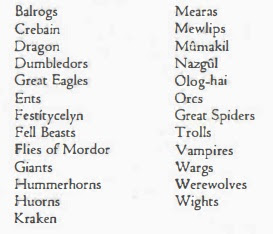
To finish my review, I'd like to say that the book works as Race and Class, and now I realize its heavy parallel to D&D (the 6 stats under other names, using levels, saving throws, etc). It has a LOT of subraces, some of them I don't remember at all being in LOTR (Where do the woses appear in the movie? WTF is a dorwinadan?) and has a nice bestiary:

(WTF is a Dumbledor? wasn't he from another franchise altogether?)


Searching for the old MERP manual, I've managed to find their publisher's second attempt at Lord of the Rings rpg, called simply "Lord of the Rings Boardgame", dating from 1991. And of this one I want to talk a little more, because from the design point of view, it feels very tempting to use, to learn from and to modify.

While MERP (1982) is percentile based, ICE's Lotr (1991) is entirelly 2d6 based. It is much more basic than its older counterpart, which can be bad or good sometimes. But from the "design" point of view, there are some points that caught my attention.

There are 12 skills: 

1. Strength
2. Agility (balance and nimbleness, also initiative)
3. Intelligence
4. Movement (Speed, MV per turn)
5. Defense (adds to armor)
6. Melee Bonus
7. Ranged Bonus
8. General (covers climbing, riding, etc)
9. Subterfuge (thief checks. Too many dexterity divisions, or its just me?)
10. Perception (do I see the trap?)
11. Magical (you get 2 spells per bonus, also adds to the casting roll)
12. Endurance (your HP). 

skills from 1 to 11 can be as high as +3, and as low as -2

skills from 6 to 11 are "bought". You get +5 bonus to divide between them, but any skill that is not raised gets a -2 instead. I like that this makes a great gap between casters and non casters, fighters and non-fighters, or sneaky hobbits and clumsy human. I would go even further and make it so the first +1 only applies to a favored weapon, which is more in line with the original books (Legolas=bow, hobbits=slings, for example) but using another of the same type (ranged/melee) only drops you to 0, not to -2

skills from 1 to 5 and Endurance depend entirelly on your "class"

There are nine "race and class" packages that you can choose. They all come in a pregen sheet with weapons, equipment and certain skills raised or lowered. The classes and examples it cites are:

Hobbit Scout (Bilbo, Frodo)
Elf Scout (Legolas)
Human Warrior (Eowyn, Boromir)
Dwarf Warrior (Gimli, Thorin)
Elf Warrior (Glorfindel)
Human Ranger (Aragorn)
Half-Elf Ranger (Elrond)
Human Bard (Gandalf)
Elf Bard (Galadriel, Arwen)

I love how the wizard word is totally out of the question. Wizards in this game are treated as bards. The spell list is kind of short, there are like 20 spells with the classic ones (sleep, fireball, identify shit, etc). Anybody can cast spells providing they raise their "magical" skill, so classes are little more than archetypes that help players to get into the character.

Combat is done in a grid, with movement, attack and half attacks. Depending on the action you take (spells go first) you act in a given order, with same actions acting in order of agility. Attack rolls use a small table modified by offense/defense of those involved, with the high results resulting in straight leaving your opponent unconscious (a natural 12 always does, at least, knock out your opponent) or maybe even killing them. Armor adds to your Defense bonus and substracts from subterfuge, magic and movement.

Too basic when compared with the MERP one, maybe. I see the simplicity of the 2d6 as a great excuse for complicating it using the critical tables of the original one!

Strength doesn't affect combat in anyway, which is plainly stupid in a game that uses it as a factor. Seeing that weapons are differenciated by modifying damage done, but with two handers and  unarmed combat having penalties to hit, I think that a good way to fix this is to have Strenght offset those penalties by a proportional amount. 

The resting 8 of the 28 pages ruleset is dedicated to an oddly specific set of questions. My copy is in spanish, but I found a screenshot that will speak better than my words:


The choice of 14 situations that are thoroughly covered by the rules is very interesting, it says a lot about the challenges that the PCs are supposed to face and about the world they tread on. In which other fantasy game did you see a page dedicated to SNEAKING THROUGH TOWN BY NIGHT?

 None of the books have anything such as "procedural challenge generation" or anything that drives the game forward other than the GM's work, but LOR makes up for it as it was originally printed in a book alongside a module (bigger in pagecount than the actual game), so you could say that the first module was part of the game itself. 

(Skimming through it it seems that it features at least Gandalf and Merry as NPCs, as well as a couple of Stone Trolls)

It is cool to know that if somebody decides to play it after all this years, after lots of iterations and games on the Middle Earth that have been published, s/he can find some help with My_GaMe_FiXeS in this small corner of the blogosphere. Nice coming into spring for everybody. 


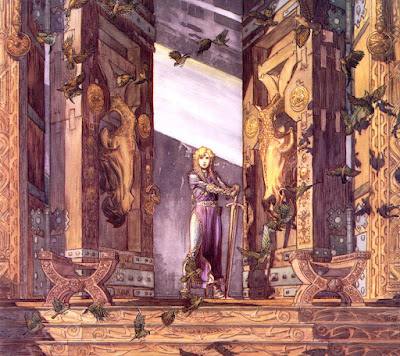
Eowen at the doors of Meduseld


Tuesday, November 9, 2021

Current Houserules (november 2021)

This is the current ruleset I am using. The arguments for some of these points are already listed somewhere on the blog, others are mostly consequences of applying them. For monsters, equipment, procedures not listed, etc I use BX. The rest is heavily modified:

* Hit die are hits. Damage rolls and hit points do not exist. Instead, a succesful hit takes away one hit dice, which are the equivalent of health points. This would effectivelly equate wizard's and fighter's health as there are no different HD sizes, but fighter types tend to have more HD (see next point)


* Classless. Roll 3d6 in order, then what normally would be your class feats are instead derived from attributes in this basis:

STRENGTH
9 or less: -1 HD (you have always a minimum of 1)
12-13: +1 HD, you can wear plate
14: +1 melee attack bonus, +1 open doors
15: +1 HD, +1 critical range in blunt or 2 handed weapons
16: +2 melee attack bonus, +1 open doors
17: +1 HD
18: +2 melee attack bonus, +1 open doors

strength is also equal to the inventory slots you have before you go encumbered, then you can carry +3 more.

DEXTERITY
9 or less: -1 to thief skills
12-13: +1 to thief skills (1+X chance in 6 to perform Move silently, hide in shadows, pickpocket, etc. Also against saves requiring reflexes you can roll this if its higher than your chance per level)
14: +1 AC
15: +1 HD, +1 critical range with swords or ranged weapons
16: +1 to thief skills
17: +1 to thief skills, you are peak thief by then
18: +1 AC

dexterity measures how much a thief you are. That is why it doesnt get much into missile fire, just a little.

INTELLIGENCE

9 or less: as in 10, but without any bonus. Might be useful for narrative purposes somehow.
10: You have a starting background skill, choose that skill during the game at any moment. It cannot be stealth or combat related. You have a +1 when using that skill or knowledge in any way)
12-13: +2 to any background skill
14: You have an X in 6 chance to produce an item related to your background. On a fail, exhaust this gift until downtime.
15: +2 to a skill
16: +2 to a skill
17: +1  to a skill. You have a second quantum item, see above
18: +2 to a skill

intelligence represents the "technical" part of thieves, more in the specialists LOTFP version. There are some setting established background skills already, like healing, alchemy, bushcraft or trap/lockpicks

WISDOM

9 or less: haven't thought of an appropiate penalty. Maybe there is none.
12-13: +1 to magic skill. It is used to perceive magical auras around, using magical items and casting spells. To do so, fire the spell and roll your skill or under: a success fires the spell instantly (even prior to an incoming attack) and the spell is not lost. On a failure the spell is lost after casting, and it comes off at the end of the round. Being attacked or disturbed impedes you from casting this turn.
14: +1 magic skill, +1 spell. Your first spell! it takes a big roll here to have a character start with spells (16'20% of the characters will)
15: +2 spells
16: +1 magic skill, +1 spell 
17: +1 magic skill, +2 spells
18: +2 spells

the spell list is also condensed so there are fewer spells, with some of them being merged into one, and many of them scaling with charisma. For now I am making it on the fly, but will edit to post the final list. As many other things on my houserules, you can start with a non-specified spell and say which one it is during the mid game, but you keep them once you choose them. Personally I think it its fairer for players to choose spells once they are immersed on the context of the game, even if it can be seen as "cheating". It also makes char gen much faster.

CHARISMA

9 or less: -1 reaction
12-13: +1 HD
14: +1 reaction
15: You or your party can re-roll one save per day
16: +1 reaction
17: +1 HD
18: +1 reaction

Charismatic characters with no other abilities have some HD and survival resources on their own to represent their "chosen one" aura. For now I am winging it with the number of hirelings, they never reach high numbers anyways. Some spells increase in effect (duration, effect, etc) based on the reaction bonus, so its a good choice for wizards to have as a secondary attribute.

CONSTITUTION COMBAT

9 or less: You are a non-combatant. -2 to attack
12-13: +1 HD, +1 to attack with your favored weapon (choose a type at anytime, but stick with it afterwards)
14: +1HD, +1 to attack (all weapons). Your critical hits deal triple damage instead of double.
15: +1HD, +1 to attack (all weapons)
16: +1HD, +1 to attack (all weapons)
17: +1HD, +1 to attack (all weapons)
18: +1HD, +1 to attack (all weapons)

Basically your fighter level. At 18 you stack a +6 combat bonus, which is one less than what a level 10 fighter has. For now this is fine for me.


* Weapon differentiation:

Martial weapons deal a critical on a 20 (x2 hits). 
2 handed weapons deal it on a 19-20. 
Swords/bows and blunt/2handed weapons increase this range by one based on dexterity/strenght respectivelly.
Daggers have -2 to hit. It is widelly accepted that a range of +2 to hit equates to +1 damage in the common rules, so having one die step less in damage can be translated in the big picture by reducing their to-hit.
Bows have also -2 to hit, to separate them from crossbows which need to be reloaded every other turn. Also crossbows only receive half of your attack bonus.
Hand to hand combat is also at -2, and only deals damage on a succesful "open doors" check
Combat stunts like disarming, etc can be attempted by taking a -2 to the roll. Target might get a save or an "open doors" check to prevent it (whichever is higher)
Armor uses the rules already explained on a recent post (leather +2 mail +3 plate +4, shield +1, helmet +1, being a hero level warrior [combat 14 or over] +1 )
Dual wielding: One re-roll per combat, using the off hand weapon numbers. If the secondary weapon can be used to parry, you can choose an enemy roll landed against you to be re-rolled, keep the best result in both cases.
Using a katana/bastard sword with 2 hands instead of one grants you an extra attack per combat. Once is expended, its out until the "combat music" ends. This is a weird rule I introduced because the main fighter race in the setting is modelled after korean samurais which usually used a single katana and I didn't want them to be mechanically gimped in game for no reason.


* Initiative: 

The side with the single combatant of highest HD goes first, they chose which character starts. After every combatant, a member of the opposing side that hasn't acted yet takes its turn, until everyone has done their actions.
Ranged weapons that are readied can be shot reactivelly. Spells can also be cast reactivelly if a roll is passed (see wisdom, above)


* No clerics. Anyone can learn all spells. Turning undead works by forcing a reaction roll, when prompted by any display of holiness (holy symbols, bless/light spells)


* Leveling up looks like table below for everyone, with numbers based on the fighter chart. Im considering lowering them 5% for everyone, as if every character was a fighter with some strength as prime requisite. Saving throws are unified, with situational penalties as I see fit, and they are all done with a d6. I have grown fond of this method and bonuses-penalities feel significantly stronger. In addition save + hd, PCs who level up roll 2d20 and choose two attributes: if they roll over, that attributes increase by +1


Saturday, November 6, 2021

XP to level one? or lowering the bar to level 2?

When playing old D&D (bx, od&d, etc )ou might have noticed that the XP needed to get from level 1 to 2  is the same that one would require to get from level 2 to 3. It contrasts with the further progression that doubles the XP required each level, up to level 9-10. 


This might be a bug or a feat, who knows? It makes no major problem, though I've been tempted to change it sometimes .For example: fighters and halflings get level 2 at 1500 XP instead of 2000, then they have 2500 more to reach level 2 at 4000. It makes the progress more gradual and lowers the bar a little, so the characters can get the first level up (which is the most decisive for dungeon survival) earlier. Magic users can take it at 2000, while thieves level up at 1000, to go for the round numbers.

There is another approach, pointed up by an anonymous person I met on the internet. Which is to have each class start at level 1 with half of the XP they need to reach level 2, so the "double each level requirement" math is fixed. I loved this idea because it makes me think that level 1 characters have a "past" that gave them some XP and made them into the class they have now. This would explain why some NPCs have no class, and the ones they have it its because they bought it with some XP

Curiously, as each class has its own XP requirements, it can be interpreted on some ways. Thieves require less XP and magic users require more, so its a good reason in-game for why there are much more thieves than wizards in the world.

To put it in another way, you can have a 0 level character with no XP and no class. Then, when he gets the XP required to buy the first level of the class that he wants to become (1000 for a fighter, 600 for a thief, 1250 for a magic user), he can "buy" it. If you are not into 0 level play, you can just have the PC start with said XP amount straight away.

Note that they will need double that amount to get into level 2, so we are running into "levels with same requirements" again. What a mess haha. Well, we can fix it rounding them down a little: 700 for the fighter, 500 for the thief and 1000 for the magic user. 

when you become a level 1 fighter and your level 0 pals get jealous


Monday, October 19, 2020

Building a machine from unused parts

was reading something about the "forgotten rules of rpgs today", the ones that are usually handwaved or something. It listed three: item weight, crafting rules and XP. I'm not going to tell if this is true or not, but it made me wonder "could a ruleset be made using ONLY those, as the mechanical parts?

Here is an attempt for the skeleton. There is no setting or context, only rules; but maybe the latter might suggest the former.

You can carry (4+level) weight, or +2 weight and be encumbered; with items having set weights in a list. Characters fill one weight slot from their inventory when they suffer a wound. Leveling makes your character either stronger (and thus being able to carry and withstand more) or experienced with packing stuff so they are easier to transport. For now it remains abstract.

Certain actions cannot be taken while encumbered, as climbing a rope. Certain monsters are fast enough to catch you encumbered, but not when you're not. 

Certain items can be crafted from mixing 2-3 other items during downtime (as always, the full list of items and permutations is the heavy part of the game, but yeah it can be done). Certain mixtures are trickier than others and might require a roll with a probability fixed on the formula (X in 6 is sufficient). Mixtures can also have level requirements as part of their recipe.

You also have a chance to get mixtures "done" during an adventure, by rolling 1/2 your level on a d6. If you achieve it, it represents that your character had the intuition to prepare the item during the last downtime (so, every level represents your character getting more and more wise and foreseer)

Your party gets 1 XP whenever you recover 1 treasure, but you can only split it between party members if you have enough XP for everyone to receive equal share. (If you have 5 XP in the pool, and you're three party members, during downtime you can give 1 XP to every member and leave 2 XP in the pool)

level 1: 0 XP - level 2: 1 XP- level 3: 2 XP - level 4: 4 XP - level 5: 8 XP, etc

Combat having no rules at all means that fights have predetermined outcomes: they are either automatically won if the players fight (though it might have unwanted effects, like atracting more enemies, etc) or automatically lost if engaged, unless certain items are used (like flaming oil vs a troll, silver vs a vampire or using a smoke bomb for the party to flee). Now I think about it, it sort of feels like a LucasArts graphic adventure resolution: find the right combination and maybe it works; but with added level advancement. 

Even as I feel that this could work (It even makes the game diceless if we push it) I also think that it requires much work from the GM to decide ad-hoc (or for me, the author to decide preventivelly) if a single item is either worthless in a determined situation or, for the contrary, if its as powerful to obliterate the encounter. In the end, it can be interesting if you have a "dungeon" in which you can control many of the possibilities the players might try (like, for example, in a LucasArts game), but harder to implement in a larger environment with lots of different types of encounters and items.

So there is another approach, starting from the simplest combat system I could devise: When two people get into a fight, they both roll 1d6 and the highest roller deals 1 wound to the opponent. Based on that, there are some sub-rules:

- Certain items can deal more damage, add a bonus to the roll or bypass combat entirelly. That's the only way to get some kind of combat bonuses, and that's what they're for; all the focus on inventory has to pay somehow.

- Certain items can be used when there is a tie: they can from offset the tie, to win the combat straight (like, maybe, a tie in combat can represent the perfect moment to show a mirror to the medusa)

- Certain monsters can also have abilities that trigger on a tie. Unless the monster ability says so, if the PC has a tie-triggered item, the item's ability is the one that triggers instead.

- Even if there are many monsters, they count as one. Monsters only roll once per turn, but get a bonus on their roll (+0 to +5) depending on their strenght, size or numbers. This also influences the wounds that the enemy can take. Certain monsters deal more than one wound. Armor (if exists) absorbs 1 - 3 wounds.

- If many PCs confront the same enemy, only one of their rolls is taken into account, they choose which one (the highest one normally, or maybe a roll that ties to use an effect). When a monster deals damage, the party can divide it amongst them as they decide. A character that is downed is still alive, but must be tended to walk by their partners, and counts as 3 weight.

What kind of setting and adventures does this inspire? no attributes, no classes, no characters being stronger than others... Sort of a situation where all the PCs are mostly equal in capacities but with a crafting ("skill"?). If I think of items as magical compounds, I picture the titular Alchemists of this blog name. If I think of items as common items, I can see it being a game of gang kids getting in any kind of trouble armed with whatever they find available. Treasure can be anything that is relevant to the genre: from different pieces of Jewelry to the control of a neighbourhood block. And you, when you read them, what kind of game did you see in this rules? 


Thursday, April 23, 2020

Monks & Mummies: XP


(AKA Monsters and Monasteries)

This is for a game I want to put together little by little. Basically is OSR D&D but slightly based on martial arts animes and JRPGs.

One thing that didn't worked for me about the PCs being wandering fighters is that those kind of people don't seem too much interested in gold; so making XP for Gold Retrieved seemed a little dissonant about character goals / player goals. Yeah, sometimes a master can require a treasure for paying their training but is hard to justify that monks are delving in dungeons all the time and no training.

XP per monster killed, though more fitting at first, is also not perfect as it incentivizes players to fight whatever shit they're thrown. And the trope of the fighter asking another fighter to battle just to "test their styles" is cool, but is not something you can base a game upon (Also, straight sweeping hordes of monsters works in JRPGs due to the videogame mindset, but grinding during hours with no lateral approaches doesn't traslate well to pen and paper)

What I've done is to write a check list of milestones in order to guide the players through the sandbox. Every box ticked is 1 level, but doing each must involve a serious quest so as a GM you have to make it challenging

[_] Help an NPC to solve his first world problem
[_] Defeat 1 monster with your same HP*, alone
[_] Defeat 1 monster with higher HP*, alone
[_] Defeat 1 monster with double HP*, in group.
[_] Build a Dojo or other similar Settlement; and mantain it for a time (basically put a trouble on the way and make the PC overcome it)
[_] Join a sect or swear fealty to a kingdom; and upheld its honor in a quarrel or defeat a rival sect
[_] Train under the supervision of a master and complete his quest (the quest might be the lesson itself or just a test to be judged worthy)
[_] Set up a personal quest and achieve it (decide it at anytime, GM put a trouble on the way)
[_] close a wound about your character's past (a revenge, a lost love, a promise, etc. Decide it at anytime what it was, no need to do it at creation. GM put a trouble on the way, if you achieve the atonement, tick this. If you dont, a new chance will appear on another quest)
[_] retrieve 800 GP
[_] retrieve 2000 GP
[_] retrieve 5000 GP
[_] retrieve 10000 GP

There are more than 10 so you don't have to undertake all of them to reach level 10 if playing by classic standards (If you're an evil person, I'll spare you from helping that NPC, man) and some GP related points so I can still run a dungeon/heist or two if needed

I'm thinking on adding one about "[_] having your character wounded with consequences". As in losing an eye, an arm, etc; or just changing the way you play your character dramatically; but it must have mechanical (- to a stat) and narrative consequences for it to be fairly executed; and also a mechanic to make this happen in combat organically.

Other alternatives that still use XP is giving XP per victory after a battle encounter (to prevent unnecessary carnage, getting an enemy surrendering, admiting defeat or fleeing counts as victory) or XP given by Masters (Master is a "monster" on the random wilderness encounter. His special powers is giving a trial or a quest. On fulfillment, his treasure is just XP without the GP that usually accompanies it)

*Change it for HD (Hit Dice) instead of Hit Points for classic conversion, but I use it like this for some reasons I'll explain on further entries.