Showing posts with label initiative. Show all posts

Monday, July 24, 2023

Simultaneous Initiative

The other day I found this by reading my daily OSR stuff, and this paragraph offered me a new wonderful paradigm. I'll just cite:

OD&D has no such thing as Initiative and to my way of thinking it should never use it - EVER!

OD&D uses Parallel Actions; everyone does what they do in a round and then results are applied.

You engage the orc and you are both circling and looking for an opening… roll your attack, oh you hit it for 7!

The orc falls to its knees mortally wounded, in a last effort it swings at you missing and falls face down on the ground in front of you.

The orc got its attack in even though you killed it.

Oh Oh, sometimes things should not happen in a parallel order.

What you can do is apply reasonable results to any situation. Lets say our heroic fighter decides to attack a troop of orcs armed with pole arms. The pole arms should do about the same damage if they get a hit as our hero's sword. Yet our hero has decided to be The Man in this situation and is charging at pole weapons, this is not a good idea. He needs to clear those pole weapons before he gets his attack roll. Thus I would judge that the orcs get to roll their attacks before he gets past their pole weapons and can strike with his sword.


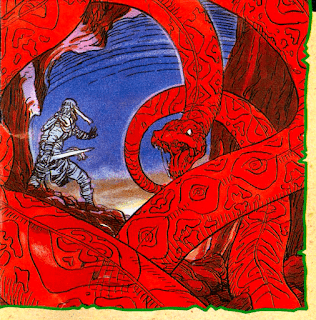
Legend of Shalice (pc-98)


With simultaneous initiative, the problem in my head was at first: "then who declares actions first?" But for some reason, I was enlightened this time: It doesn't matter. You can make it so combatants can re-declare actions based on what their opponent is doing, and then the opponent, add infinitum. Or just say that you can hold action indefinitelly, with some rounds ending with motionless combatants in both sides because they don't want to give an opening. But the truth is that you can probably run games during months before you have to resort to one of those.

Just a good point to remember: If PCs and NPCs power grows parallel to each other the game might keep balance, but with simultaneous initiative, the possibility of mutual kill increases depending on how easy is for both to hit. 

Wednesday, January 19, 2022

initiative without rolls


Happy new year! it feels like its been a long time without posting. Or maybe its just my feeling. This blog has been boosted like x 10 in visitors since Alex Schroeder mentioned me in his blog (its not like I had many before lol) and I should be making only hIgH qUaLiTy posts from now on. 

I want to take an entry to talk about my initiative houserule, and why I like it so much.

Basically, unless there is surprise, initiative goes to the side whose has the single member with more max HP, and only in case of a tie I randomize it.

Additionally to this, I don't do the "one side acts, then the other side acts" thought it would work perfectly I guess. I complicate it a little further by making the side who acts choose one member which acts (for the monsters, the GM chooses) and then, after the action, a member of the other side acts; and this goes on until everyone involved has taken its turn. Arrows and Spells can be shot reactivelly (spells require an armor-based roll to work in time) but doing so it consumes the turn of the shooter/caster.

I've been playing like this in my last campaign and I've accostumed myself a lot to it; to the point that I don't think I am going back. Combat is much more swift (much more combined with the "no damage, just take a Hit Die" houserule), and also it makes interesting effects in game: 

Having a Fighter in the party is suddently much more important. His instincts help everyone to take the lead on a fight, even if he doesn't fight himself: Maybe he just grabs the initiative so the thief can do something first. Tougher monsters are also scarier, because their sheer "speed". Suddently it also matters in which turn of the watch the monster appears: if the fighter is asleep, the monster can get a great advantage.

The "alternate sides" thing also adds an element of strategy for the players, something that its often missing from combat when a game makes the fights a little bit abstracted. Using this (also abstract) ways to control combat gives PCs more buttons to press which, in my opinion, adds a +1 to old D&D.

Sometimes I like to distinguish swords from the other weapons because they add a little bonus to HP only for initiative purposes. They are the weapon of heroes after all.

And thats it. 

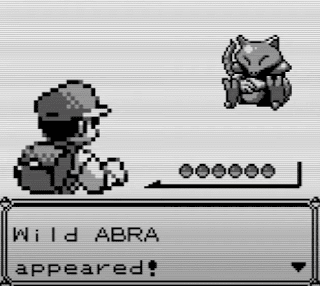
I want to note that it is also possible to make a much more gamist initiative without rolls, and I found out by playing pokémon this last weeks.

In the GBA games, initiative works like this: both trainers choose their movement at the same time, then the pokemon with most speed acts first. Stats are very granular, so having a tie is very rare.

Certain movements have priority over others, regardless of speed. For example, taking a potion or changing pokemon goes always before any attacks (there is but one attack AFAIK that specifically strikes before retiring the pokemon). Some attacks have a "quick" tag that makes them go before the enemy, and there are slow attacks too, which work the opposite way.

It could very easily be ported to tabletop by assigning a sort of speed stat (dexterity is the easiest) and then listing which kind of actions have priority over others. This very choice can lead to very different combat systems and tones (for example, if healing has priority over attacking, if spells go first or last, etc). 


Offtopic: If you speak or understand spanish and like the game, I reccomend you this awesome Team Rocket Edition hack by Dragonsden. You play as a Team Rocket recruit acting parallel to Red and Blue in the original Game Boy games. The lore of the game is so good that its really a pity that its not "official", I am really enjoying it!

Monday, August 17, 2020

Minimalistic D&D-like, part 4: Surprise, reaction, treasure rolls


Reaction and Surprise rolls, when apply, are made once for the whole party involved. Certain monsters have bonuses or penalties to this rolls integrated on them.

Reaction rolls:

1, 2, 3- Monster is immediately hostile
4, 5 - Monster is neutral for now. Maybe its studying you or maybe just minding its own business. Dont disturb it! You might also try to befriend it.
6 - Monster is friendly. Some monsters might make offers when this happens.

Possible mods: disadvantage if you've hurt similar monsters recently, if it hates the light of your torch, if you're armed, etc. Advantage if you give a sign of respect or share an alignment, etc. (like in 5e: roll an extra die and choose the most advantageous/disadvantageous)

Each monster entry in the guide might have specifics guidelines on their behaviors for each reaction type. An hostile bandit might try to rob the players by force, a neutral one might try to lure them by feigning partnership, but a friendly one might honestly try to sell them loot, or honestly propose the party to join him in a dishonest job.

Note for myself: It can also be done by not having a reaction table at all, but having each monster to have a random list of dispositions on their descriptions. 

Surprise:

1 - Monsters get the drop on you: Only monsters act the first round
2 - Monsters get the first turn
3 - Monsters get the first turn
4 - You get the first turn
5 - You get the first tutn
6 - You get to surprise the monsters: Only PCs act in this round

This roll can be made w.ith advantage or disadvantage on certain situations: for example, hobgoblins always force a disadvantage, while sneaking on distracted guards gives you advantage.

After one side plays a turn, the other side plays one, until all characters have acted their turns. Each side decides who goes from among their members


Treasure

Instead of having treasure types, having each monster have a treasure rate that represents the overall richness/status of the monster. Then you roll for treasure once or more times, depending on the time the monster has spent looting. 

For example, having a crew of patrolling goblins have 1d6-2 treasure hidden somewhere. A dragon rolls 2d6, and you roll three to five times depending on its age.

Then there should be a table like this:


1 - No treasure/personal items.
2 - Personal tools
3 - 10 GP
4 - 50 GP
5 - 100 GP
6 - Magic item
7 - 500 GP
8 - 500 GP (in jewelry)
9 - 500 GP (in masterwork)
10 - Scroll or Magical consumable
11 - Special (prisoner, secrets, notes, information)
12 - 1000 GP