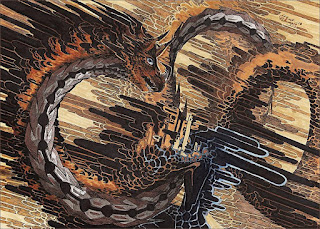
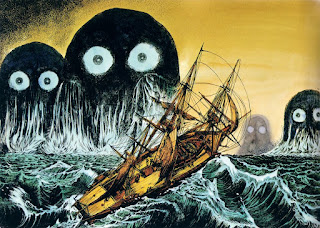
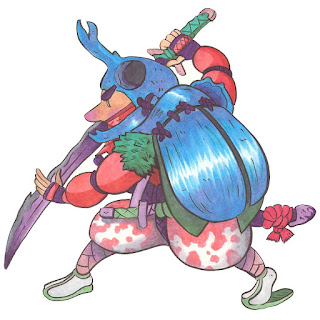
After all this time, I've still haven't found a magic system that I like 100%. This is the current iteration I am working now. Numbers are made to fit with this other previous work, though they can work with any rules using roll-under, under a magic stat such as wisdom or intelligence.
Thursday, January 27, 2022
Magic system sketch v2
After all this time, I've still haven't found a magic system that I like 100%. This is the current iteration I am working now. Numbers are made to fit with this other previous work, though they can work with any rules using roll-under, under a magic stat such as wisdom or intelligence.
Wednesday, January 19, 2022
initiative without rolls
Happy new year! it feels like its been a long time without posting. Or maybe its just my feeling. This blog has been boosted like x 10 in visitors since Alex Schroeder mentioned me in his blog (its not like I had many before lol) and I should be making only hIgH qUaLiTy posts from now on.
I want to take an entry to talk about my initiative houserule, and why I like it so much.
Basically, unless there is surprise, initiative goes to the side whose has the single member with more max HP, and only in case of a tie I randomize it.
Additionally to this, I don't do the "one side acts, then the other side acts" thought it would work perfectly I guess. I complicate it a little further by making the side who acts choose one member which acts (for the monsters, the GM chooses) and then, after the action, a member of the other side acts; and this goes on until everyone involved has taken its turn. Arrows and Spells can be shot reactivelly (spells require an armor-based roll to work in time) but doing so it consumes the turn of the shooter/caster.
I've been playing like this in my last campaign and I've accostumed myself a lot to it; to the point that I don't think I am going back. Combat is much more swift (much more combined with the "no damage, just take a Hit Die" houserule), and also it makes interesting effects in game:
Having a Fighter in the party is suddently much more important. His instincts help everyone to take the lead on a fight, even if he doesn't fight himself: Maybe he just grabs the initiative so the thief can do something first. Tougher monsters are also scarier, because their sheer "speed". Suddently it also matters in which turn of the watch the monster appears: if the fighter is asleep, the monster can get a great advantage.
The "alternate sides" thing also adds an element of strategy for the players, something that its often missing from combat when a game makes the fights a little bit abstracted. Using this (also abstract) ways to control combat gives PCs more buttons to press which, in my opinion, adds a +1 to old D&D.
Sometimes I like to distinguish swords from the other weapons because they add a little bonus to HP only for initiative purposes. They are the weapon of heroes after all.
And thats it.
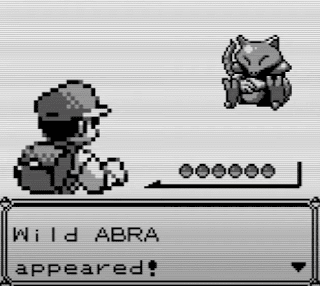
I want to note that it is also possible to make a much more gamist initiative without rolls, and I found out by playing pokémon this last weeks.
In the GBA games, initiative works like this: both trainers choose their movement at the same time, then the pokemon with most speed acts first. Stats are very granular, so having a tie is very rare.
Certain movements have priority over others, regardless of speed. For example, taking a potion or changing pokemon goes always before any attacks (there is but one attack AFAIK that specifically strikes before retiring the pokemon). Some attacks have a "quick" tag that makes them go before the enemy, and there are slow attacks too, which work the opposite way.
It could very easily be ported to tabletop by assigning a sort of speed stat (dexterity is the easiest) and then listing which kind of actions have priority over others. This very choice can lead to very different combat systems and tones (for example, if healing has priority over attacking, if spells go first or last, etc).
Offtopic: If you speak or understand spanish and like the game, I reccomend you this awesome Team Rocket Edition hack by Dragonsden. You play as a Team Rocket recruit acting parallel to Red and Blue in the original Game Boy games. The lore of the game is so good that its really a pity that its not "official", I am really enjoying it!
Monday, December 20, 2021
make your own anime
I want to test the rpg principles I talked about on the previous entry, and I needed a spark. So I re-made an old table for making your own anime; and then I will try to make an RPG out of it! hahaha.
If you want to join, cross the first letter of your last name with the month you were born and find out yours. Write a short summary of the plot and describe 3 to 5 main characters (you can use behindthename for finding some names quick). The idea is that if Samurai Champloo and Cowboy Bebop could hypotetically be made rolling on a similar table, we can come up with similarly awesome 26 episode animes.
|
Asteroid |
January: Gospel |
|
Barrel roll |
February: Serenade |
|
Cultist |
March: Noir Jazz |
|
Dragon |
April: Mantra |
|
Emerald |
May: Boogie |
|
Frontier |
June: Fugue |
|
Galley |
July: Sōkyoku |
|
Hadou-ken |
August: Blastbeat |
|
Istari |
September: Synthwave |
|
Judoka |
October: Shoegaze |
|
Kaiju |
November: Blues |
|
Lancer |
December: Dub |
|
Midgar |
|
|
Ninja |
|
|
Oasis |
|
|
Pyramid |
|
|
Qilin |
|
|
Raygun |
|
|
Shoggoth |
|
|
Transhuman |
|
|
Underworld |
|
|
Valkyrie |
|
|
Witching hour |
|
|
XI century |
|
|
Ys (city of) |
|
|
Zombie |
|
I will roll with a dice myself, because I already set up the table knowing my own month and name lol. Optionally, you can add the words Hotel or Squad to whatever name you get, after or instead the second word. Post results!
Thursday, December 9, 2021
Why OSR
The best thing for me about Old D&D and its clones (and what brings them over any other games) is, in my opinion, how they are the only rpgs that care about procedural game generation. That is: you have a looping mechanic that keeps the game forward, by the chemical reaction of the PC's advancement rules (XP for gold) and the dungeon stocking chart (or hexcrawl generation chart). As long as you have this, there is a game going on.
This allows the GM to wholeheartedly assume the role of a "referee", instead of burdening him with the tasks of being an Omniscient God, a plot writer, a world builder, a wise mathematical balancer and fun enforcer. I'd say even more: He is allowed to be all these things whenever he wants (you can build a dungeon manually, or even build a complex, dungeon-less adventure) but you are not forced to. If the players go on an unexpected way, or if you don't feel creative at any moment, you can just fall back on the pure game: let them do it! it is built for that. In a sense, (old) D&D is the only rpg that provides you the game rules AND the game.
This is something that all the 90s books that came after failed to understand. Games like L5R or Vampire give you only the game rules. Then they give you a 300 page lore brick, from which the GM must make the game himself, having to rely on "mission" based sessions to play. Well, this is not something impossible to do: I'm sure there were and will be many successful campaigns with that! but it lacks the mechanical structure to support the game on itself and the point of playing it becomes abstracted or null once the GM pulls the foot 1 gram from the gas pedal. In a sense they are exponentially much more "GM demanding", specially if you are not heavily invested into their worlds. (This, of course, is something that capitalism fixed quickly by selling you modules and splatbooks).
This doesn't even make them better suited for story-based games. Actually I think D&D is still better at it: you dont have the pressure to control everything, which in turn opens the possibility of a sandbox and freedom of choice for the players. This makes any plots you actually want to use a nice story to be explored and played with, instead of a fragile railroad that must be protected against the player's actions. And, underneath all of it, you feel that you are in a fair fight against the odds, with no helding hands by the GM. This is, for me, what makes the OSR distinct and OD&D the king of rpgs.
I'm not saying that it is the only way, though. I am sure that mission-based games could be systematized too. The core could look like a mission generator that would... (just brainstorming);
a) generate quests appropiate for the PCs and tone of the game; maybe even let them choose between various missions; each one with some definite "end state", whether succesful or not.
b) generate as many details of the whole quest as possible, prioritizing the spots that the game wants to show or test. Some games might allow or even encourage player's input on what is going to appear
c) a mechanic that determines how does your character and/or the world change after the quest is done or failed. This can take the shape of leveling up, something more or something else (game-world progress based on character actions is something that is rarely coded in rules, and I make this note for myself in order to explore this in the future)
DnD 5e and many allegedly OSR hacks such as Knave, Maze Rats, etc also fall in the second type of games. The case of Dungeons and Dragons Fifth Edition is specially painful as the game is 300+ pages long and manages to cover neither mechanics for the game loop nor a setting, beyond the implied on the monster manual. Its just rules and rules and rules but no real structure behind it. (I frankly cannot understand how people manages to play it without handwaving 90% of it).
I have loved, still love and even made some ultra light rpgs (I use to collect all PDFs I can find); but after this revelation I realized that most of them make no attempt to provide gameplay beyond Character Creation + Combat + Skill checks. Which again, can be good and can work with a GM wanting to do all the rest, but now I feel as a designer that focusing the same amount of rules in mechanically enabling a specific biorhythm is much more interesting. You can change or adapt the resolution system of any game and make it work much the same (for example, the 2d6 hacks of D&D or using point buy vs random generation) and while the chances of success/defeat could vary, the nature of the campaign would not.
This is why I think the term CORE RULES suits better my idea (the rules that enable the intended biorhythm and create game) than the idea of conflict resolution rules: A core is something deep that cannot be changed without changing the whole thing in the process.
To close this post, I will run over some games (no particular order or reason) and see which of their mechanics are centered on bringing the game forward, which in my opinion is their most important rule:
Everyone Is John uses the other players actions as the current player's obstacles, so the game is actually generated by your friends. The core rules are those that focus on switching the control of John. Conga Mummies is a boardgame version of this approach.
Ghost Lines has got a very nice mission based generator that activates once the PCs get side jobs. The actual ghosts are generated collectivelly by asking questions to the players. It also features an astonishing collection of missions, ghosts, employeers, city events, implied setting, etc for a game so small, Definitely an inspiration to have as reference. Check out this fan-made variation using chtulhu dark's resolution system to further prove my point that the core rules of a game are not related to action checks, but for content generation. Some other games like Lasers and Feelings also uses a random mission maker but doesnt really create a solid framework beyond an oracular prompt.
Lady Blackbird, by the same author as above, uses a really cool way of unlocking character abilities: You all play named, premade characters; and advance in power by advancing your personal plot towards certain points, so it makes gamist fucks like me to advance the plot whether you like it or not, making also things change for the world and everybody.
Ryuutama has a clunky and weirdly complex unique way of handling most things (stamina, travel, magic), with the GM ability to influence the outcomes of the party in the shape of a ryuujin (dragon spirit guide more or less) being a really, really cool and original thing. But none of them answer once the pcs ask: "What now?". The game has prepared for that with another sub-section: The collective city and world builder guide, and the adventure writing guide (basically guidelines on how to write an "episode" of which the PCs will be part).
Apocalypse World and its derivatives use the list of fronts, which trigger sometimes on failed moves, and a set of principles which act as a subjective proxy for "genre fairness" (evidently we are all human and might interpret principles differently). While this can certainly work, it becomes much more streamlined and concise on small PBTA games such as Sagas of the Icelanders than in more generic like Dungeon World, as the moves they invoke on a failure tend to be more specific and carry more narrative weight. Check World of Apocalypse for an actual flowchart of the game pace.
Into the Odd (full edition) has a similar approach to B/X, but with advancement being earned each mission (the game defines a mission as "going out and returning with something worth showing"). Curiously, the One page edition of ITO has a very cool dungeon and random encounter generators that can completely map your first quest; and might serve as a base to build new generators for the next ones.
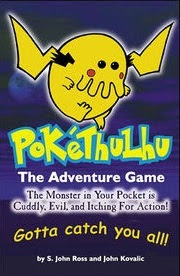
And, making a callback to a recent entry, Pokethulu might pull you in for the very sake of catching new pokethulhus, (much like the original game, that is what I call faithful adapting), so as long as a monster exists and the PCs want to catch it, you only have to put it somewhere on the map, then put more trouble on the way. Still, in my opinion its a game that would really benefit of having random encounter tables, proper hexcrawl rules adapted to pokemon travelling speeds and capabilities (like flight, swim, run, dimension bending or others, really, this could be awesome) and little more power granularity between monsters. But maybe I will take care of it someday. I guess that their creators never thought that somebody would ever take so seriuously what they believed to be a joke game!
Basically we can conclude that there are (at least) four ways from which game content can be brought to the table:
1.Procedural generation
2. Taken straight from a book (such as monster manuals, using a pre-written adventure or following Pendragon's campaign straight)
3. Created communally by the table or
4. Leave it to be created by the GM, this last one being the most used by commercial and indie rpgs alike, with more or less "guidance" from the book.
This methods of course can be mixed in different proportions for different games. I invite you to think how does your game (or a game you like) does it and post it, so we expand this list in the comments
Wednesday, December 1, 2021
wilderness (pointcrawls vs hexcrawls vs squarecrawls)
On my last sessions I had not hexed paper and I had no patience to draw a map hex by hex, so I made a bunch of vertical and horizontal lines and used a square grid instead.
Its not the first time I do it, and while I like the aesthetics of hexes, the truth is that squares do fine. You can assume the same size for them as you would with hexes (6 miles as the standard set by this post). You can move horizontally or vertically, but not diagonally (that takes 2 moves). It might not make much sense a priori, but hexes are not realistic either, they are a different form of abstraction. And as a gaming abstraction they work just as fine. Maybe more, as the players can verbalize their movements better in the case you don't want to share your map with them. North! South! East! West!
I also tested something for simplifying movement that I wanted to use, which I liked a lot and will probably stay on the game:
Movement rules:
clear terrain/road: 3 hexes (or squares, of course)/day, or 4 if using a horse.
forest: 2 hexes/day
mountain pass: 1 hex/day
* Players can use the night's rest to travel 1 extra hex instead, if there is enough visibility to allow it; but penalties for not resting might appear
* Weather conditions such as a storm will reduce the hexes travelled by one, and might increase the chance of getting lost.
* Characters who are encumbered also reduce the travelling speed by one, and if this takes your travelling speed below 1, its up to the GM to decide if it becomes 1, becomes impossible or has a X in 6 chance of being fruitful (a fail indicates that you must rest before you finish walking the hex)
* One encounter roll per day travelled, and another one for each night passed.
Today I have also read this and this other classic links about pointcrawls and got me thinking: Hexes and squares are just 6 and 4 path-nodes after all. Why not switch to pointcrawls and embrace a new abstraction? Well, I am studying the pros and cons of the idea, and from the top of my head, here is a list of them:
* Pointcrawls dont have to be "one location away is one step", which was my main concern. Roads can be segmented on any number of steps, as Chris Kutalik points in the first link, and every road have its own chart of dangers. You will have to sleep on the ground still in a random forgotten place sometimes.
* Getting lost can still be portrayed, it might actually be easier. If the PCs get lost, they automatically end up in another "road" that starts at their last "node", at the same segment of distance. For example:
If you are at the red dot, travelling from B to C, when you get lost, you are randomly "teleported" to any of the yellow dots. If there is a terrain type associated with that road point, GM will tell you and you will or won't be able to determine if you are lost by that description.
* Hexcrawls fail to portray impassable barriers of smaller granularity of 6 miles. If confronted by a mountain range, it will always be passable, even if with a small travelling speed. Pointcrawls on the other hand are designed for thriving with impassable barriers. Sea, Mountains, etc.
* Pointcrawls are faster to draw. They don't have to even be scaled in the map, as the roads take care of that, so they lend much better to make maps "artistic" (see picture below).
* Though it is true that a too linear pointcrawl (see picture above) removes the players agency, one with enough bifurcations or nodes prevents this completely. "A hex is just a node with 6 paths after all", as we said earlier.
* New paths between two nodes can be unlocked during the game, which cannot be done on a hexcrawl easily (it is hard to make an area "secret" or "locked" naturally). For example, new ways can be found just as you would a secret door (you find it on a 2 in 6 by spending time searching for the trail), maybe they are found after you have been lost in there (recovering from a "get lost" roll makes you find a shortcut through the woods), attempting something that wasnt plannned (players decide to sail down a river, and at its base they find a way that goes upwards, to where they came. This one is used a lot on old Lucas Arts adventure games) or doing something in game that unlocks the path (if you help the kobolds build that tunnel, you connect the city + the sea under the mountain)
* A pointcrawl can be drawn over a preexisting, not-gridded map by deciding its points of interest. This can also visually guide you into how does the area look, or which kind/frequency of encounters does it have. For example, in this map below you can adjust encounters depending on which terrain the roads are crossing at that point.
Friday, November 26, 2021
A note on clerics and [review] of Tomb of the Serpent Kings
Monday, November 22, 2021
[review] Pokéthulhu; my first game as GM ever
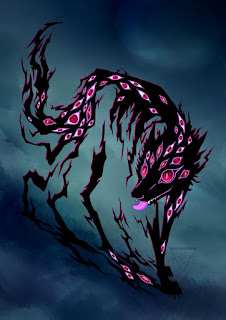
I drew a handful of pokethulus in a few minutes. I just sketched some shits on a paper, then added lightning, horns, extra eyes, extra anythings, fire, water, wings, tails and random weirdnesses and they were perfect. I was into the mythos while my players weren't; but I made a lot of references to them anyways, with one of the toughest pokemon being straight up ripped from Hellsing's Baskerville (one of the PCs captured without combat, with a lucky roll of a pokéball throw). There was a mechanic that incorporated making up quotes for the pokethulu fictional show in exchange for ¿successes? but we did away with that completely.
Edit: Some related link about somebody wanting to make a pokemon campaign focused on exploration.