Thursday, October 21, 2021

Helmets + Heroic Aura: Rearranging Armor Class


I am using a house rule regarding AC, with the objective of de-emphasizing the need for plate armor and promoting the active use of helmets (they cost 25 gp in the equipment list, but nobody is sure on what they do). Also I get to implement something that I love to represent, which is fighters getting better AC by their own merits. 

Base AC: 10

Armor: Leather +2. Chain +3 or Plate +4

+1 for using a shield

+1 for wearing a helmet

+1 for being a fighter and having reached the Hero level (4) or having reached name level with any other class

This is the classic AC17. After this, only dexterity bonuses or magical gear apply.

The helmet itself carries no downsides but for being an extra item for encumbrance purposes, and a little more expenditure of money. The greatest upside is that, when is situationally appropiate, you know who is wearing a helmet and who isn't.

It bothers me a little that some PCs can buy the best armor available in the game right from the start, or shortly after. In this way, the minimum and maximum armor levels are the same but hopefully it can motivate players to use plate armor in the battlefield, but have an easier time choosing lighter armor in a dungeon for stealth and mobility purposes. It can also give a good reason to go shirtless with a helmet if you want to play by the genre's staples. 


Thursday, October 7, 2021

Math on d6 D&D: building around d6 pool combat.

(Warning: This post is heavy on numbers. Is meant to be used as a reference)

Working after the steps of Homebrew Homunculus again, I was trying to make my own try at taking damage rolls from combat. One hit is one hit, so it takes one hit dice. Easy! Is fast, simple and requires almost no conversion. But of course, this started the design train: you change a little thing, and then you change another one to go with that, and end up having a whole different game. 

I thought on making the fighter do multiple attacks instead of getting to hit bonuses. Even if the average damage per round was the same, there could be the chance that each round none of the attacks landed, or any number of them would. This way, there would be a kind of "variable damage" without any damage roll taking place!

But there is a number of how many d20s one can roll simultaneously in a confortable way. So I ended up doing what I had already done other times, and made it with d6. Only that, this time, I did the math.

This an orientative chart on the damage output of an attacking PC (where a 100% represents doing consistently 1 hit dice of damage per turn over time) depending on their class/level and his/her opponent AC.


This other table shows the % damage output of Fighter 1 (a just made level 1 fighter) versus enemies with various ACs (still not assigned what kind of AC do these numbers represent, so I described them as Base, fightey, soldier and tank). He rolls 1d6. Fighter "2" rolls 2d6 and Fighter "3" rolls 3d6. Each result equal or over the AC is a hit, and again, the chance of dealing consistently one hit every turn is represented as 100% damage.


If we look at fighter 1 alone, we see that AC 3 is slightly easier to hit than the "base" in d20. AC4 is a little worse than d20 leather (actually corresponds to wearing just a shield in the original), AC 5 being roughly equal to chain and AC 6 being an enchanted +1 plate and a shield.

Then it shows the chances of hitting the same enemies by fighter "2" and fighter "3". The brackets are there because we dont know yet at which level would a character get their second and third attacks.

As I see it, if we take the AC6 (Tank) to be roughly equivalent to Enchanted Plate + Shield, the chances to hit are pretty similar than if Fighter "2" was a 7th level fighter and Fighter "3" was a 10th. Well, this can be worked with. We can make it so the fighters gain other bonuses like weapon expertises, AC bonuses by using armor or extra HD until then, and the additional attacks are gained at those levels. But I'd lean towards granting them the attacks earlier, as otherwise the fighter hasnt any kind of "to hit" bonus until then. 

But if we look at the lowest ACs, we see that the increments compared with their d20 counterparts are crazy: the chance to hit base AC is doubled, and the same could almost be said about the next higher one. AC5/chain stands a little better with just slight increments. This informs us that our new high level fighters are roughly equally capable vs higher armored foes, but are about double as capable vs unarmored foes or lowly armored mooks. This could be seen as a problem or as a boon. For one, I can see it fixing the problem in which high level fighters had to slay hordes of mooks one by one. Now they can just send an attack to three 1HD enemies at once with a great chance of killing them, without the aid of any cleave or "you can attack as many 1hd enemies as your level" houserule.

But why is the "2d6 take worst" represented at the top of the table? Well, that is for wizards and other non-fighters. While in the d20 combat all classes start with the same "to-hit" bonus (with some of them having a +1 for fighters) in the practice the fighters always deal a little more damage because they can afford using all weapons, while wizards are restricted to daggers and darts. 

By making wizards roll with disadvantage, we make the a distinct gap between fighters and wizards even at level 1, which feels very right to me. 
Then, the idea is this: when PCs use lesser or tricky weapons like daggers or such, they roll as 1 "combat level" less, so fighters roll with disadvantage at level 1. Wizards still roll with disadvantage, there are no lower levels than 2d6 take worst.
This solves two problems right the early stages of the game design: it creates variable weapon damage when there was none, and implants an invisible system of weapon restrictions: wizards can carry and use any weapon, but they won't do more damage than they would with a staff or a dagger anyways.

Though AC6 is the maximum available, you can always make monsters tougher by other means. For example, a giant might only be attacked after you dodge his attack first. If you are hit by him, you suffer the wound and cannot act for one turn. I kind of like this limitation because it invites me to be more creative with monster rules. 

How does strength, magic swords, etc factor into this? Well, this is the foundation. We will have to slowly figure out the rest around it, but that will be part of a new entry. For the sake of making reading this easier, the provisional codename and blog tag for this project will be d6 d&d.


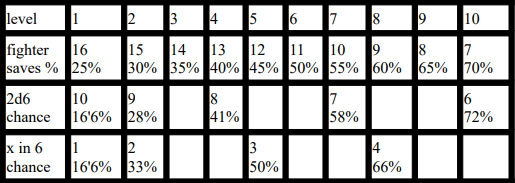
On the other hand, working the saves is very straightforward. Here is how I would set them (taking the fighter saves as a guide) using 2d6 vs target number, or 1d6 roll under (the one I am using right now). I dont think I'd advance them more than that. A 100% chance of saving should never be reached, and there has to be room for other bonuses that might come from elsewhere.
(Notice the drop on the saving chance for first level characters. Today I had one guy rolling his 1 just before running into a pit trap with only one hit remaining. Yeah!)

********************  EDIT:  ***************************

I have been working deeper on this. I will drop here two more tables, and I will explain in a moment.

This one is the classic to-hit, ascending AC table. Leather and Chain are merged halfway into a new armor (a kind of "light armor"). To check how much would a shield add to each armor, just add a 5% to it. The percentage is the rate in which a hit is delivered each turn, with a 100% meaning that the character will stastically deliver a hit per turn.


The next table shows the same, but using the d6 pool. Armor is arranged in two types: Light and Heavy. This is mainly because each step up and down the AC means much more in this situation, and I didn't want armor to be so much decisive in combat. Instead, being a fighter gives you +1 AC straight away, moving you beyond non-martial classes right at level 1. Fighters (and clerics if you use them) are also the only ones able to use plate, so wizards and thieves have to search for alternative ways to go higher than AC4. 


The number in brackets is the damage if the target uses a shield. Shields deflect 1/3 of the succesful strikes. So, when you are hit, you roll in this (provisional) table:

6-deflect
5-deflect if you are a fighter
4-hit
3-hit
2-hit and shield breaks if enemy is Strong AND has a mace/axe
1-hit and shield breaks if enemy is Strong or has a mace/axe.

If you are hit by a flail, you roll twice and get the worst result. They are designed to bypass shields after all!
I love how this approach creates a lot of granularity with very little. Yes, the shield roll adds another roll to combat, but they are only going to come up with shield-wearing characters and monsters (which are not too many). The same is true for flails. And we took out damage rolls anyways, so in the end there are much less rolls involved.


In this way, shields are comparativelly much more protective the less armor you wear, which makes some sense given on how they are supposed to behave in real life. A fighter in loincloth gets much more relative cover by a shield than a fighter in plate does, even if the total numbers are higher for the latter.

The shield roll can also adapted to monsters that don't have shields, be it to increase their ACs or for other purposes. For example to add “counterattack” abilities; such as “additionally to its normal attacks, a dragon breathes fire over an attacker on a shield roll of 6”

The next point: 2 handed weapons. When you get hold of a greatsword or greataxe, you are given a red die instead of your normal one. When that die comes up a 6, your weapon crits, doing 2 hits of damage. As you go building your pool you get more d6, but only your red dice can cause critical hits. 

The increase in damage by armor and by levels is shown in the F1, F2, F3 d6 crit rows. As you can see, the damage increases much more in comparison against the more armored enemies than it does against the less armored; which makes them specially important when fighting giant enemies or fully armored knights. Again, I love when simple mechanics help portraying something logical in-game, even if its not excesivelly realistic. As levels go up, the crit die matters a little less, but remains a great advantage.


Next: adjusting fighter improvements to fighter levels

d6 F1 works similar enough to d20 Fighter 1 when targeting plate armor. d6 is a little worse, but d6 with a 2handed weapon is a little better, so one evens the other. The same is true for fighter/light armor and the other ACs when using shields. 

For Fighter/naked and Wizard/naked, one handed weapons work a little better than in the d20 counterpart, if compared with the same leather/chain median, with 2handers being way better. 

Is hard to choose to which Fighter attack levels do d6 F2 and d6 F3 correspond, as damage output is exponential the less AC your enemy has. Adjusting the levels VS fighter/plate armor leaves lesser ACs much easier to hit. Adjusting to lesser ACs leaves AC6 much harder to hit. 

Personally I feel that they should err on the side of generous; for two reasons. First, the d20 fighter will also benefit from multiple bonuses like strength (available even at level 1) or magic weapons; which on the d6 counterpart are very hard to implement. Second, there are only 2 pool upgrades, and until then the fighter has not much progression beyond getting more HP. If I wait for the fighter to have the corresponding "firepower" on the d20 to give him the pool increment, he will be always under the power curve. If I give them a little earlier, he will be sometimes over the curve, and sometimes under it, so the "power curve" will be more tightly followed, paradoxically. 

Following this points, I can see F2 adjusting to fighter 3 or 4 (level 6- 7 for a wizard), and F3 being somewhere around levels 7 or 8. If using a level 10 cap, wizards should never achieve this combat range. 


Next: Lesser Weapons.

Daggers, staves, maybe bows. I originally had two ideas for them, which are:
- rolling with disadvantage
- rolling normally, but on a 6 you must roll again. You keep the second roll, and this time a 6 is a hit.

I like the second one better, as it represents the attacker using that result to "find a weak point" in the enemy's defence, then you are able to hit normally. This decreases drastically the effectiveness of the weapon towards the greater versions or ACs, but still allows for 2 handed, lesser weapons strike x2 on a hit.
The math for both approaches VS ac is unfolded at the table above.
When you get an increment of the pool, they also go up one step, so F2 rolls 1d6, and F3 rolls 2d6.

Alternativelly, fighters roll all their normal dice and just roll again if the highest one is a 6. This one is very wild, as they are more likely to roll again the more dice they have, but in the end they get surely better output anyways. I should do the math but a priori it is cool and feels organic. If there is some kind of "bow expertise" might work by allowing spending a turn aiming to automatically get the first 6.

This approach also allows for easy unarmed combat: You must roll again on a roll of 5 or 6, and in your second roll all numbers are valid.

Note to myself: If I end up doing weapon expertises, they should not increase dice rolled in any way, but work as a side help, never equiparating themselves to a "fighter level" but useful in all levels. A good one for trained swordsmen is "you get an extra attack once per combat". A good one for martial artists might have something to do with shield rolls.

Edit: Note to myself #2: As maces/axes have a small upside on shield rolls, trained or not, swords should have one too. A good idea is to have them increase the initiative by one level (see the post I did later about Initiative without rolls)

Thursday, September 30, 2021

The Zoz Koans (anonymous)


Dungeon Master Foo instructed his students:

“There is a line of dharma teaching which emphasizes the flexibility of the Old Ways. The referee must be prepared to improvise, as when a random encounter indicates orcs, and the referee then has to decide what the orcs are doing and what their goals are when the party encounters them.

“But there is another line of dharma teaching, exemplified by the Guide of the Great Patriarch Gygax, which emphasizes the thorough creation of a milieu before play can begin, and various sutras on the preparation of dungeon levels, wilderness hexes, and the keeping of strict time records.

“Now, tell me: which teaching has the old-school nature?”

After a silence, Nubi observed:

“Dungeon Master, these teachings may conflict.

“Improvisation is necessary, but it seems a necessary evil, for if the referee simply makes everything up on-the-fly, the milieu will lack cohesion, and verisimilitude will suffer. Furthermore, there is nothing to stop the referee from using on-the-fly decisions to railroad the player characters. Surely, these are not the Old Ways?”

Dungeon Master Foo nodded in agreement.

“On the other hand, it is well known that creating an entire fantasy world is both tedious and impractical, and many a referee has succumbed to burnout, or wasted years on worldbuilding pointless and uninteresting details. Surely, these are not the Old Ways?”

Dungeon Master Foo nodded in agreement.

“What, then, is the proper dharma path?” asked Nubi.

The Dungeon Master spoke: “When the eagle flies, does it forget that its feet have touched the ground? When the tiger lands upon its prey, does it forget its moment in the air? Begin with just three hexes of wilderness, one town, and one dungeon!”

On hearing this, Nubi was enlightened. 


Read the rest in Playless Play: THE ZOZ KOANS OF DUNGEON MASTER FOO


Tuesday, September 28, 2021

[illustration] World of Guweiz


Official Soundtrack of the post:

This post is dedicated to the artist called Guweiz who did all of this drawings. One of his recurring themes is this samurai girls, under a seemingly endless rain. Doing who knows what, at what seems to be the outskirts of a flooded modern city. Some part inside me remembers waking up early in autumn mornings, to walk the way up to high school on days like that. And that specific kind of magic. Lots of grunge.


This one above summarizes the essence of the ¿setting? perfectly for me. It's title is Countryside. Notice how there is a constant presence of that warm lights around the girls. Sometimes its pendants, sometimes butterflies. Sometimes lamps. As if that light hold a great importance to their survival or the missions ahead. Maybe that is why our girl came to the countryside now; to gather a little light for the road ahead.


There is something that speaks to me in this world. What kind of plot or setting would it had if it was an RPG? would this girls be the PCs or the Monsters? what do you do in a world like that? Is it a normal autumn in our world, or is it another one, smaller, where the autumn never leaves? Where you put a lamp on your door to keep your home safe from whatever is lurking there? 


Notice the giant oni armor at the background. Did she just beat him? is he pledging service? or just a dead cask that happens to be there? Whats going on in this city?


Is it all in the end a metaphor for teenage life? Why so many girls? And how do they get their XP? If you have any ideas of what this setting could be about, please tell me.


Monday, September 27, 2021

BlueLite: A debugged Holmes 1977 D&D (pdf in english and spanish)


I just bring this here to not lose track of this gem. Its made by this guy, and its a revised, clarified and reformatted version of the blue book, which also features:

* All rolls being made with a d20 (thief skills, common skills, etc have their numbers adapted to the same die)

* Bugs fixed and small improvements (2 handed weapons attack every turn as normal, Strength is added to melee damage, etc. See end notes in the PDF for more details)

* Magic items and potions are now created randomly

* Only 10 pages long, which makes it easy to use, and also being streamlined makes it easier to modify should you want to. Personally I would have used one or two extra pages for describing the monster's aspect and behavior

* Awful art, just like the original

Author's link:


Traduccion al español:

Thursday, September 23, 2021

Frontier lands as a Megadungeon (Dark Tower inspired)

So I was trying to make something playable about the Dark Tower. But instead of just using the setting, I want to just get the inspiring bits. I don't want to feel constrained by book characters or be a huge nerd about the lore details (because I know myself, and if I go down that way, I will become so obsessed with sticking with canon that I will get stuck in the research phase)
And what the hell, deep down I want freedom. Freedom to create, make and discard. There is something about me and the mystic western imagery that asks me to have a room to put the things that I might come up with.


For now, the Appendix N that I am working with is: 

The Dark Tower series (IV and VIII mostly, as they are the ones that deal most with the youth of Roland and take place on the Mid-World)
Into the West TV 2005 show (Greatly reccomended, never heard of it until recently even if it was produced by Steven Spielberg. I love how it shows the dynamics between indians and whites without plainly ignoring or glorifying any side. It might not be "really what happened" but it is consistent enough that works for me.
Final Fantasy 8 (If you think about it, the plot is easilly portable: A school state that trains young kids to kill, then sends them out in missions as "mercenaries?" "paladins?" "witch hunters?". Also the anachronistic world suits partly into the vision that I have for this setting)
This blog entry that got me thinking on "how would a Middle Earth equivalent that is based on the american frontier instead of middle ages Europe look"

The premise is that the PCs are young gunslingers (which are a sort of equivalent to knights) that have some missions given by their elders, and must eventually go on a quest for the Dark Tower (or the setting equivalent, though we could probably use it without copyright issues as it comes from the Robert Browning poem)

Then I started to look into quest-based games to see how they worked (Pendragon, PBTA, etc). But since I got enamored with the OSR sandbox style, where PCs decide their path and gain XP for tangible shit (gold by default) games where the GM gives the players a quest through the voice of an NPC dont work much for me. I just dont know how to do it anymore. 

My idea is to run the whole game as an overworld megadungeon: Lets explain.

Gilead, on the left side of the map, is the starting town. To the west of it, the wilderness works as a Level 1 dungeon floor (with LVL 1 adequate monsters and that). On it, you can find one or more passages to get into new lands, that work as a dungeon level 2. And such until you get to level 10 where the Dark Tower in its field of roses is supposed to lay. This works as an invisible wall: theoretically there are no walls that prevent you to pick up a horse and riding towards it, but you will have to find your way into 9 "dungeon levels" that will trigger crazy monster encounters unless you have leveled up yourself.
Certain pathways might make you "skip levels", so, for example, you can go from the lands of level 2 to the lands of level 6. But an scalated progression from 1 to 10 is always possible if you search for it.

This might remind you a little about the "West Marches" thing, but it differs in something crucial: The lands you cross are significantly bigger. The West Marches supports itself on the premise that all sessions begin and end in the base. In here, once you delve beyond level 2, you are not supposed to sleep home anymore. Reaching out into the wilderlands is a matter that might take years.

Of course, you might find other towns in the wilderlands. But the more you go west, the less chance for them to be "civilized", and the more for them to be weird. That if they are not a bunch of ruined stones by the time you get there. It is not easy to stand long in a level 5 belt. Of course, you can rest assured that those who do are powerful warriors, have adapted somehow or are doomed to perish.

Just a reminder to put battle horns on the inventory list

As I don't want to bother in creating a world in detail (neither would do it with a megadungeon) I will try to rely on random generators. Lets say that when you find a settlement, roll 2d6 + the dungeon level
3-6 - Small outpost (Farm or the like)
7-8 - Small Town
9 - Bigger Town or City
10- Fortress
11 -Nomad tribes
12- Small outpost (abandoned)
13- Small town (abandoned)
14 - Big town (abandoned)
15 - Fortress (abandoned)
16-17 - Nomad tribes (weird)
18-19 - Small outpost (weird)
20-21 - Small town (weird)
22 - You reach the Dark Tower

Basically the further you get from Gilead, like it is the bastion of civilization that allows other towns to flourish, the rarer the conventional towns are. Instead you go getting more and more indian tribes, fortresses that can withstand the hazards or failed attempts of colonization.

This is an over simplification, but more or less what I have in mind. Actual geography like mountains, rivers, sea lines, roads, etc overlaps with this "danger" map.

Over this base, I leave some thoughts:

* All of this starts counting to the West of Gilead. But on the other directions there might be other lands differently incremented in level (so they are, in a way, locked; until the PCs level up a little). The city being the home of a true knightly force is the reason that it can stand being confronted with high level lands. Still, the only level 10 land ever is the one in the west, where the tower lies.

* The level might spike suddently by entering a dungeon or a cave

* The idea of having towns set on the level 4 wilderness pairs nicely with the feeling that frontier towns must have felt like, back in the 1820s

* Once again (and this is a problem I stumble upon many times) XP for gold makes no sense if the PCs are from a knightly or elevated condition, with interests beyond the material. At least if the only XP comes from gold. XP must come at least from three sources: treasure (including outlaw bounties), monsters and (yes, I know what I said) quests. But I got some ideas to automatize the latter by derivating them from the "lawful" or "friendly" monsters in the "bestiary". 

* I love technological anachronisms. I found out that one can advance technology very hard without breaking the fantasy feeling as long as you leave out mass production (Gilead being a monarchy should be able to stop untamed capitalism), roads and cars and, to a degree, TV. A land that is not practicable to pave or to build cable lines for much time (because there are constant earthquakes, monsters or other disturbs) gets rid of the latter two, and, by taking away trade, slows the first one considerably. Still, you can have a small amount of autogenerated electricity (windmills, etc) and power up small devices as fridges, music devices, battery powered tools, radios (I love the idea of a radio station transmitting across dangerous wastelands)... etc. On the other hand, I love the trope in which electrical devices are more prone to being tricked against you by evil sorcerers.

* That being said, technology is set around the 1840s, with the advenment of the Colt Dragoons. Gilead aesthetic and customs are set on the arthurian era, with a foot on the medieval retellings and the other deep down on the primitive celtic myths.

* The world is divided on "baronies" or "states", some of which have big cities as capitals and some of which are in safer zones than others. At some point, the frontiers are blurred and the territories are unclaimed. Trains only go to level 3 zones, and are dangerous to drive beyond that. The most extended way of transport is by horse.

* Alternativelly, a map in the style of Out Run in which each level bifurcates into two, which later might converge, can also work.

*The whole bulk of the game is the bestiary. That is where the color comes from. Depending on what to choose as encounters, the game will feel more medieval fantasy or more "real life west", with my ideal point somewhere in the middle. Dragons, elves and dwarves as we know them are 100% off this project (I see many people talking about pinneaple on pizza, but little thought is paid to those who mix dragons and revolvers). I'm not doing goblins with guns either, and no different races are to be playable. Curating a good bestiary is the key to get the feeling straight. This takes me to the next point.

* In normal D&D, you hit monsters with swords until they come down. And it is ok, it makes sense somehow, because of myths, tradition or internal archetypes. But firearms are different. Firearms are not suited to kill monsters but men. Sometimes men with other firearms. This is just one of the reasons that makes fighting and monsters different in classic fantasy than in western clichés. It is ok to have monsters with great hp that will go down in a few shots. Most high level humans are to be like this. But it is kind of anticlimatic to shoot down fantasy monsters to death. Thats why I'm thinking that beyond human, undead, really big animals (its tricky to draw a line on where a big animal stops being an animal and starts classifying as monster: lets think about the Graboids) or demonic versions of those (Like in the White Buffalo, or Mononoke Hime) many monsters are not to be of the kind that can be "just shot"; but rather to be avoided, dodged by pure horse speed or dealt in other ways (and maybe shot once they are weakened or unmasked). From the top of my head I'm thinking on:
- Enormous sand hands that form on specific parts of the desert and grab/swallow people into the ground (See Stephen King "the beach" short story)
- Wraiths. I just love using them.
- Psychic leeches of any kind
- Colossus of the Shadow of the Colossus type
- Monsters that can pass as friends or manipulate the PCs' acts.
- Any of the entries at the Goblin Punch's Book of Tigers suits a setting like this better than common fantasy bruisers.
- Same can be said about Lovecraft-type monsters in general. 
- Non-monster threats such as thinnies or starkblasts (Dark Tower), earthquakes, tornados, stampedes, plagues, etc. 
- Its OK to have a gunfighting vs missile wand confrontation with a sorcerer, if previously you have succesfully defeated some number of his magical tricks.

* Some staples that are very useful in this genre are magically enhanced bandits, really clever tacticians, former gunslingers turned evil, indian tribes who are wary of strangers, cultists of forgotten gods and any equivalent of John Farson's rebellion, all of them normal humans (except when they are not, of course)

* PCs game loop usually ends at Gilead, though if they can find other rest/supply settlements, they can also use them for the services they have. Maybe some specific resources (like revolvers, for example) can only be found consistently on that base city. But thats OK. There is one last trick that you can play at some time, which is to stage the downfall of Gilead at a certain point of the PCs life. Be sure to make it so a part of it is played by NPCs and monsters (Doppelgangers? Evil Wizards?) that the PCs have previously met. That will make it personal. 

* If you've read Wizard and Glass, you might remember that all factions relied on things like the wind direction, the height of the grass or wether or not it would rain (remember when Cuthbert and Alain dug the powder ditch to blow up Citgo?). If you are sneaking somebody and you are both riding a horse, there is a chance that the horses will say hi to each other and give your position away.
I think its important to use all that. I want players to wait until the moon is full to attack a given enemy, because it allows them to see them from a greater distance. I don't know how to implement it beyond learning all those tips by heart myself and using them, but I find it worth it.
I want to also encourage them to search and use real life survival tips, with rolling only required if it has a chance to fail. In that sense, your player's knowledge is your character's knowledge. Unless the GM says otherwise, if you describe what you do and it makes sense, you have at least a chance that it succeeds.

* On the hp/gun damage scalation as a problem in high levels (or when a gun does d8 damage but a level 6 character has 6d6 hp). To keep the gunfighting a constant threat, characters should stay at relativelly small HP levels. A high level character having 18 HP seems like a sensible maximum. This goes more in line with the original Into The Odd rules. I already did something with it on the Trigun adaptation and might be useful to do it here (though I must add that, even though Trigun might share many things with the Dark Tower, it doesnt really vibe in the same world/themes or whatever, at least for me. Trigun is biopunk, here we lean more on good old magic)

* Horses, horses, horses. When I said I want to rule this as a megadungeon instead of a hexmap, I mean it. Each "area" is mapped as a series of interconnected "rooms", even if intangible. Each ·"room" is randomly generated (lair, treasure, settlement, empty, crossroads, path blocked, etc) and the rules for movement mirror those used in dungeons, but the movement used is instead: Horse (Sprint), Horse (March) and Walk. This makes each exploration turn takes more in-game time, so things that depend on time, like healing, take more time. And that feels nice. I should also be learning more things about horses, because I'm a city guy. I think that horse tending and behavior is a largelly ignored aspect in both fantasy and western settings; as well as horses themselves. Which is weird because their imagery is so powerful that a almost any character on a horse looks automatically like an adventurer.


Sunday, September 12, 2021

The Dark Tower: A Rant


This post is about the Dark Tower books by Stephen King. Probably won't make much sense if you haven't read them before. 

I read the saga somewhere around the change of century, when only four of the seven books were written. I was really on fire with that shit, like fucking mad. I remember reading this old web for theories (god, I found it! so many memories!) on the old age of internet, and thinking about the tower all day at home, high school...

I eventually read the last three and I didn't like them much. Not just the ending, but the whole three novels feel much different than the rest, and I think most readers might agree with me. I will try to explain what I feel by saying this: While the first four feel (as Stephen King says they were) channelled more than written, as if a voice related to the tower itself was telling him when and what to write, at intervals, during thirty years; the last three feel like written analitically and in a rush, trying to make sense of what he had been writing "in a trance" up to that day. There are many other things that can be blamed for this, I guess (Self inserting as a character, devaluating Roland's world by inserting a Keystone World set in our era, trying to build a Stephen King expanded universe, lots of epic build-ups wasted like Flagg, Crimson King, Patrick Danville, Eyes of the Dragon crossover, etc) but I think the reason I cited is the most overlooked, and maybe the reason for all the rest. 

In a way, I feel that the setting became sort of "spoiled" and that the only way to enjoy them is to "forget" the newer books, as if they didn't exist. Sometimes I think about how cool it would be, after I saw the entries about "1937 hobbit as a setting" and the "What if Star Wars episode IV was the only Star Wars movie", and I go even deeper: What would happen if only Roland's youth scenes were the story?


And by this, I mean all the collected flashbacks: Cuthbert and Roland at the hanging of Hax the Cook, the manhood test with Cort, the whole Mejis arc, the whole Wind through the Keyhole (alongside the fairytale on it!) and the spare comments of Roland all across the books: "I once saw a man called Flagg turning a man into a dog". Cutting down all the obvious ties with the real world and New York, and focusing on the ripe lore of the Mid-World. I think it would almost stand on its own as a good story: it has enough foreshadowing for the readers to picture the fall of Gilead and the final confrontation at the Dark Tower, without the needing of showing beyond that or more detailed narration. I only need to know things like that Roland and Cuthbert shot Alain by mistake at the battle of Jericho, and that something happened around the horn of Eld, whatever. Someday the Gunslinger will head to the tower, and thats all; everything ends after the Wind Through The Keyhole confrontation with the skinchanger, and Gabrielle's Deschain revelation. Sort of a weird sudden ending like the one the very Stephen King already did in Colorado Kid, but it works in my mind.

But this is a blog about RPGs! I should focus this imaginings to more practical purposes: How would The Dark Tower, Flashbacks Only work as a gamist setting? Well, at first glance, much better than the original one:

You got the epic struggle between the barony of order, descendant from Arthur of Eld, and in ultimate stance some sort of paladins of the White, versus the forces of chaos, incarnated on the more tangible threat of John Farson's rebellion, the deceptions and schemes of the evil sorcerer called Marten/The Covenant Man, and then, behind them, the Crimson King whom all of them seem to serve in some way. The Dark Tower's nature is not really ever explained (I guess that thinking about it is GM's job), but the journey towards it is a great gaming quest. The PCs are, of course, Gunslingers, either formed or in training; with duties and powers similar to Jedis with guns; but with status more akin to medieval knights. I'd like to make an entry soon detailing ideas for a setting inspired by this. But I realized that doing that would require from myself to explain possible readers and even maybe myself certain things, and that this rant would require certainly more than a paragraph: hence this whole entry.

To close this, I'd like to unfold an idea I'm holding this days. When I was reminded of the Tower this last time, I felt the urge of reading the fourth book: Wizard and Glass, that I had not read in a long time, maybe almost 20 years (I remember reading that book while on detention class at high school!). Reading it now, with my (adult? father's?) current eyes, I felt some heavy themes underlying on the book; maybe even the central core of it. I won't argument much as I don't want to persuade anyone, just state them the best I can:

The first one is the relationship of Roland and his parents. Their mutual treason and conflict represents in a minor scale the breakup of civilization that would come in the Mid-World. The chaos forces who tainted Gabrielle do the same into the world's bastion, Gilead, of which Steven Deschain is a personification. The impact on the mid-world is devastating, just as the treason was in Roland's heart. Both happenings are an allegory of each other, and lead to each other. The initial state is never to be repaired, but instead it becomes even harder and harder to even remember correctly as a faded picture. It calls for restoration through a desperate quest, which is once again sent by Roland's father: The Dark Tower was though to be a myth by young gunslingers, and most of the mid-world, but at the end of DT4 Roland points out something like "Our father's know otherwise, as is the secret they keep, I'm sure of it". It is by stepping in the shoes of his idealized father that he attempts to fix a the situation, and it is only by carrying his guns and mimicking his father's determination, overriding to extremes the joyful heart he inherited from his mother (That he could rise above [his divided nature] and willingly embrace the insanity of romance was a gift from his mother. All else in his nature was humorless... -DT4)  that he intends to do it. If anyone of you is familiarized with the tarot, you might picture clearly the Emperor vibes here.

This is more or less how I always pictured Roland's dad. 
I usually disregard descriptions and go along with what my 
subconscious gives me


The second one is the will to explore the world as we watched it when we were kids, as opposed as the one we live in today. Scientists might say its the same planet and everything, but they are just deluding themselves. 
There was a world before, one we put together where everything was at the same time very ancient, older than time itself; and at the same time, very new and with an infinite future bursting out of its thin skin. A world that was infinitelly vast and at the same time very simple to comprehend; in which laws are obvious and natural. With the years, we forget this world and put together a new one; deeming the other one as childish and false. We have formed a new worldview that fits our life better, but, to which degree is it more real than the other? We might argue that we have more life experience, yes, but, while we have lots of what we believe it is world knowledge, we also have a lot of limiting scars, fears and frustrations which (who knows?) maybe they take our eyes out ot the paths, instead of showing us them. And in any case, the former world is equally real in its way, and still calls you to be explored in search of the hidden treasures you left there unchecked. 
This world is represented in the saga at least in a triple way: the way that Eddie, Susannah and Jake perceive the Mid-World (I think it was Jake who thought somewhere in The Waste Lands: "this world is really dangerous, yes, but is much more real"). The way in which Roland remembers Gilead; and the way the world, including the nostalgic/magical New York, is presented to us, readers.

And now that this personal short analysis is done, I will focus the next post on something related but more practical: Ideas for a game/setting that takes the good parts of the Dark Tower; preferably the ones that make it really magical. As opposed that "Oh, its a western ambiented game, we should use a poker deck to randomize it, so cooooooooooooooooooooooooooooooooool"