Tuesday, August 20, 2024

ISHI'S METHODS OF HUNTING

I am halfway through the writting of two big posts, one about the implementation of medieval hunting in D&D and one about my setting's elves; of which hunting is a foundational part. I was searching for hunting customs of native americans to compare certain procedures when I stumbled upon this 1920's book (click to read whole and for free). It can't harm to share some good thing in here, maybe you will enjoy it as much as I do; doubly so if you also like to make self bows and shoot arrows.
In this excerpt you will find examples on how "speak with animals" works, and how magical, silent elven bows are made.


Hunting with the Bow and Arrow, by Saxton Pope. Chapter III:

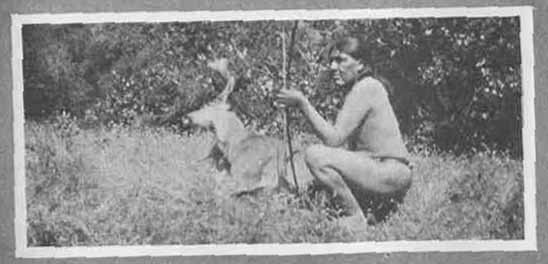
    Hunting with Ishi was pure joy. Bow in hand, he seemed to be transformed into a being light as air and as silent as falling snow. From the very first we went on little expeditions into the country where, without appearing to instruct, he was my teacher in the old, old art of the chase. I followed him into a new system of getting game. We shot rabbits, quail, and squirrels with the bow. His methods here were not so well defined as in the approach to larger game, but I was struck from the first by his noiseless step, his slow movements, his use of cover. These little animals are flushed by sound and sight, not scent. Another prominent feature of Ishi's work in the field was his indefatigable persistence. He never gave up when he knew a rabbit was in a clump of brush. Time meant nothing to him; he simply stayed until he got his game. He would watch a squirrel hole for an hour if necessary, but he always got the squirrel.

He made great use of the game call. We all know of duck and turkey calls, but when he told me that he lured rabbits, tree squirrels, wildcats, coyote, and bear to him, I thought he was romancing. Going along the trail, he would stop and say, "Ineja teway--bjum--metchi bi wi," or "This is good rabbit ground." Then crouching behind a suitable bush as a blind, he would place the fingers of his right hand against his lips and, going through the act of kissing, he produced a plaintive squeak similar to that given by a rabbit caught by a hawk or in mortal distress. This he repeated with heartrending appeals until suddenly one or two or sometimes three rabbits appeared in the opening. They came from distances of a hundred yards or more, hopped forward, stopped and listened, hopped again, listened, and ultimately came within ten or fifteen yards while Ishi dragged out his squeak in a most pathetic manner. Then he would shoot.

To test his ability one afternoon while hunting deer, I asked the Yana to try his call in twelve separate locations. From these twelve calls we had five jackrabbits and one wildcat approach us. The cat came out of the forest, cautiously stepped nearer and sat upon a log in a bright open space not more than fifty yards away while I shot three arrows at him, one after the other; the last clipped him between the ears.

This call being a cry of distress, rabbits and squirrels come with the idea of protecting their young. They run around in a circle, stamp their feet, and make great demonstrations of anger, probably as much to attract the attention of the supposed predatory beast and decoy him away, as anything else.

The cat, the coyote, and the bear come for no such humane motive; they are thinking of food, of joining the feast.

I learned the call myself, not perfectly, but well enough to bring squirrels down from the topmost branches of tall pines, to have foxes and lynx approach me, and to get rabbits.

Not only could Ishi call the animals, but he understood their language. Often when we have been hunting he has stopped and said, "The squirrel is scolding a fox." At first I said to him, "I don't believe you." Then he would say, "Wait! Look!" Hiding behind a tree or rock or bush, in a few minutes we would see a fox trot across the open forest.

It seemed that for a hawk or cat or man, the squirrel has a different call, such that Ishi could say without seeing, what molested his little brother.

Often have we stopped and rested because, so he said, a bluejay called far and wide, "Here comes a man!" There was no use going farther, the animals all knew of our presence. Only a white hunter would advance under these circumstances.

Ishi could smell deer, cougar, and foxes like an animal, and often discovered them first this way. He could imitate the call of quail to such an extent that he spoke a half-dozen sentences to them. He knew the crow of the cock on sentinel duty when he signals to others; he knew the cry of warning, and the run-to-shelter cry of the hen; her command to her little ones to fly; and the "lie low" cluck; then at last the "all's well" chirp.

Deer he could call in the fawn season by placing a folded leaf between his lips and sucking vigorously. This made a bleat such as a lamb gives, or a boy makes blowing on a blade of grass between his thumbs.

He also enticed deer by means of a stuffed buck's head which he wore as a cap, and bobbing up and down behind bushes excited their curiosity until they approached within bow-shot. Ordinarily in hunting deer, the Indian used what is termed the still hunt, but with him it was more than that. First of all he studied the country for its formation of hills, ridges, valleys, canyons, brush and timber. He observed the direction of the prevailing winds, the position of the sun at daybreak and evening. He noted the water holes, game trails, "buck look-outs," deer beds, the nature of the feeding grounds, the stage of the moon, the presence of salt licks, and many other features of importance. If possible, he located the hiding-place of the old bucks in daytime, all of which every careful hunter does. Next, he observed the habits of game, and the presence or absence of predatory beasts that kill deer.

Having decided these and other questions, he prepared for the hunt. He would eat no fish the day before the hunt, and smoke no tobacco, for these odors are detected a great way off. He rose early, bathed in the creek, rubbed himself with the aromatic leaves of yerba buena, washed out his mouth, drank water, but ate no food. Dressed in a loin cloth, but without shirt, leggings or moccasins, he set out, bow and quiver at his side. He said that clothing made too much noise in the brush, and naturally one is more cautious in his movements when reminded by his sensitive hide that he is touching a sharp twig.

From the very edge of camp, until he returned, he was on the alert for game, and the one obvious element of his mental attitude was that he suspected game everywhere. He saw a hundred objects that looked like deer, to every live animal in reality. He took it for granted that ten deer see you where you see one--so see it first! On the trail, it was a crime to speak. His warning note was a soft, low whistle or a hiss. As he walked, he placed every footfall with precise care; the most stealthy step I ever saw; he was used to it; lived by it. For every step he looked twice. When going over a rise of ground he either stooped, crawled or let just his eyes go over the top, then stopped and gazed a long time for the slightest moving twig or spot of color. Of course, he always hunted up wind, unless he were cutting across country or intended to flush game.

At sunrise and sunset he tried always to get between the sun and his game. He drifted between the trees like a shadow, expectant and nerved for immediate action.

Some Indians, covering their heads with tall grass, can creep up on deer in the open, and rising suddenly to a kneeling posture shoot at a distance of ten or fifteen yards. But Ishi never tried this before me. Having located his quarry, he either shot, at suitable ranges, or made a detour to wait the passing of the game or to approach it from a more favorable direction. He never used dogs in hunting.

When a number of people hunted together, Ishi would hide behind a blind at the side of a deer trail and let the others run the deer past. In his country we saw old piles of rock covered with lichen and moss that were less than twenty yards from well-marked deer trails. For numberless years Indians had used these as blinds to secure camp meat.

In the same necessity, the Indian would lie in wait near licks or springs to get his food; but he never killed wantonly.

Although Ishi took me on many deer hunts and we had several shots at deer, owing to the distance or the fall of the ground or obstructing trees, we registered nothing better than encouraging misses. He was undoubtedly hampered by the presence of a novice, and unduly hastened by the white man's lack of time. His early death prevented our ultimate achievement in this matter, so it was only after he had gone to the Happy Hunting Grounds that I, profiting by his teachings, killed my first deer with the bow.

That he had shot many deer, even since boyhood, there was no doubt. To prove that he could shoot through one with his arrows, I had him discharge several at a buck killed by our packer. Shooting at forty yards, one arrow went through the chest wall, half its length; another struck the spine and fractured it, both being mortal wounds.

It was the custom of his tribe to hunt until noon, when by that time they usually had several deer, obtained, as a rule, by the ambush method. Having pre-arranged the matter, the women appeared on the scene, cut up the meat, cooked part of it, principally the liver and heart, and they had a feast on the spot. The rest was taken to camp and made into jerky.

In skinning animals, the Indian used an obsidian knife held in his hand by a piece of buckskin. I found this cut better than the average hunting knife sold to sportsmen. Often in skinning rabbits he would make a small hole in the skin over the abdomen and blow into this, stripping the integument free from the body and inflating it like a football, except at the legs.

In skinning the tail of an animal, he used a split stick to strip it down, and did it so dextrously that it was a revelation of how easy this otherwise difficult process may be when one knows how. He tanned his skins in the way customary with most savages: clean skinning, brain emulsion, and plenty of elbow grease.

His people killed bear with the bow and arrow. Ishi made a distinction between grizzly bear, which he called tet na, and black bear, which he called bo he. The former had long claws, could not climb trees, and feared nothing. He was to be let alone. The other was "all same pig." The black bear, when found, was surrounded by a dozen or more Indians who built fires, and discharging their arrows at his open mouth, attempted to kill him. If he charged, a burning brand was snatched from the fire and thrust in his face while the others shot him from the side. Thus they wore him down and at last vanquished him.

In his youth, Ishi killed a cinnamon bear single handed. Finding it asleep on a ledge of rock, he sneaked close to it and gave a loud whistle. The bear rose up on its hind legs and Ishi shot him through the chest. With a roar the bear fell off the ledge and the Indian jumped after him. With a short-handled obsidian spear he thrust him through the heart. The skin of this bear now hangs in the Museum of Anthropology in mute testimony of the courage and daring of Ishi. Had this young man been given a name, perhaps they would have called him Yellow Bear.

While he shot many birds, I never saw Ishi try wing shooting except at eagles or hawks. For these he would use an arrow on which he had smeared mud to make it dark in color. A light shaft is readily discerned by these birds, and I have often seen them dodge an arrow. But the darker one is almost invisible head on. The feathers of the arrows were close cropped to make them swift and noiseless.

The sound of a bowstring is that of a sharp twang accompanied by a muffled crack. To avoid this and make a silent shot, the Indian bound his bow at the nocks with weasel fur; this effectually damped the vibration of the string, while the passage of the arrow across the bow, which gives the slight crack, is abolished by a heavy padding of buckskin at this point.

Ishi never wore an arm guard or glove or finger stalls to protect himself as other archers do. He seemed not to need them. When he released the arrow, the bow rotated in his hand so that the string faced in the opposite direction from which it started. His thumb alone drew the string, and this was so toughened that it needed no leather covering.

In a little bag he carried extra arrowheads and sinews, so that in a pinch he could mend his arrows.

When not actually in use, he promptly unstrung his bow, and gently straightened it by hand. In cold weather he heated it over a fire before bracing it. The slightest moisture would deter him from shooting, unless absolutely necessary--he was so jealous of his tackle. If his bowstring stretched in the heat or dampness, as sinew is liable to do, he shortened it by twisting one end prior to bracing it.

Before shooting he invariably looked over each arrow, straightened it in his hands or by his teeth, re-arranged its feathers, and saw that the point was properly adjusted. In fact, he gave infinite attention to detail. With him, every shot must count. Besides arrows in his quiver, he carried several ready for use under his right arm, which he kept close to his side while drawing the bow.

In all things pertaining to the handicraft of archery and the technique of shooting, he was most exacting. Neatness about his tackle, care of his equipment, deliberation and form in his shooting were typical of him; in fact, he loved his bow as he did no other of his possessions. It was his constant companion in life and he took it with him on his last long journey.

Monday, August 12, 2024

Dogs and other animals as monsters

Anybody else has felt that disphoria, when you roll up an encounter and it's just bears? I was expecting a beast; and the weird thing that a bear is actually a dreadful beast! But it falls flat. Why a bear when we got an owlbear? And, doesnt an eagle stop being an eagle (symbol of power, king of the birds) when it shares world with rocs and phoenixes?

There is no distinction in many bestiaries between real life animals and monsters: they are all listed the same, alphabetically, each with their HD and stats. But I think that in many cases they are redundant. It might only be my view on this, but let me tell you something I have slowly injected in my games:

There are no two versions of animals: wolves and direwolves. Eagles and dire eagles. Bees and Killer bees. Only one of the versions is allowed, the one that is more interesting (usually the big or magical one). I am a D&D naturalistic and I spend more time than you would guess imagining the ecology and habits of imaginary beings. On the flipside, I realized that I should not only take monsters "down to earth", but also I should make normal animals become more hyped, more "monster" if you like, in order to have a place in a D&D hexmap. Here are some examples:

Honey is distilled from killer bees. This makes it very valuable and dangerous to produce, much more when you remember that BX RAW the honey at the core of a hive works as a healing potion.
If the hive is set on a city, an accident or an attack can provoke chaos amongst the populace; though releasing the bees during an attack can also be an interesting tactic.
Hives can be wisely situated outside the cities, but this comes with it's own set of problems: being exposed to bandits, raiding parties and monsters is the first. Farmers must adapt by finding hidden havens or finding another defence strategy. The poison of killer bees is also usable through bladed or piercing weapons.

The standard size of wolves is larger than the normal one (see pic above, compared to a Trow and a Kobold), because they are more terrific that way; and I can fit 5 HP on them (on my monster conversions, normal wolves had 4 and direwolves had 6). The same problem happens with lions and tigers, when you have sabertooth tigers living a few hexes apart: There is no place for both: the existance of one makes the other lose its meaning. The concept of a lion falls apart in the moment in which an adventure finds one and says "at least is not a sabertooth tiger!!"

But what about blink dogs? RAW they have as much life and better armor than a dire wolf, just a little less average damage. Thats before we count their blinking ability in. Very tough for something that looks just like a greyhound!
Though I love blink dogs (and greyhounds) too much, I must confess that I have never achieved an interesting encounter with them. They hardly provide combat, roleplaying opportunities, not any help, despite their "lawful" nature. I have thought many times on the domestication of the blink dog. Could it be helpful? well, if a kobold could ride it and blink out of existance with it, sure. The rules are not very clear about it. But how hard would be living in a castle with the dogs blinking constantly in and out of the kitchen?
Thought its a very interesting idea to explore, I have settled giving them the traditional role of coyotes, jackals and foxes: the wild canines that, to put it in terms we all understand, chose to be rogues instead of fighters. They are highly intelligent and show great empathy, but they are not available as pets for the populace. They can be used, however, as animal companion, which in my rules is available for people with high charisma, though the animal must be feasibly befriended. This introduces more ways in which blink dogs can interact with the party: evil wizards can send them to steal your magic items and blink away; or you can get a very dope ally. As a note, I'd like to point that the pokemon Abra is a blinking fox. Coincidence? I don't think so. 


Now that we are talking about dogs; what about domestic dogs? There are few greater contrasts in D&D as between the lack of rules on their use, and the obsession of the average gaming group on using dogs (in my experience, obv). On one side, giving dogs very good bonuses on their scent and tracking abilities could be a little OP. On the other, making them meat shields at best has little flavor and doesn't paint the essence of a dog. Following the precept of "naturalizing" monsters and "monsterifying" common animals, I think that leaning on the buff-dog is the correct answer, with different power ups depending on breeds (More on this on the upcoming entry: BESTIARY) while implying that the dog breeds in the game world are also limited and not corresponding to real life current age.

In my campaign, the only crocodiles are giant crocodiles. All bears are owlbears. Monkey's intelligence is accentuated, so it can be exploited.
Ravens are a widespread communication method, and is easy to teach them words. Falcons are used to hunt, but also can be trained to kill messenger ravens. Stirges are my world's mosquitoes. Eagles don't exist, only rocs of different size. As an exception, I use spiders and snakes of all sizes, because I find uses for both.


Thursday, August 8, 2024

Trow Fortress 05: The Encounter

Both sides roll surprise if they are even able to surprise, needing a 5+ in 1d6. If both succeed, no surprise happens.

Distance is slightly abstracted: If a side has surprise, they are as close as the scenario allows and get a free turn (the other side gets no actions). With no surprise, both sides are generally aware of the other, and are as far as it makes sense in context.

After the surprise turn, or if there is no surprise, the side with the single member that has the most HD has the initiative (on a tie, the contestant that carries a sword acts first, else randomize it). After all its integrants have their chance to act, the other side acts. Certain things allow reactions: for example, if you are walking towards a target, anyone with a readied bow can make an attack against you during the way. This consumes the bowmen's turn.

When it is uncertain, I roll monster reaction (I prefer to call it "disposition") in secret, with low numbers being bad. When it comes to the bestiary, I will write specifically what good and bad means for every monster: for example, Wargs that roll low are food deprived and will attack even when the numbers are disfavorable; while an average roll means they will only attack if they are more powerful; but will stalk the party anyways to see if they can catch a stray member.

Combat goes with people taking chunks of life, step by step and critical through critical.

BUT HOW DO I MAKE ATTAKK

You roll some d6 and must get the target's AC or more:

No armor is AC3
Light armor is AC4
Heavy armor is AC5

Having four HD or more gives you +1 extra AC
Wearing a shield has 2 in 6 chance to negate any attack (non fighters actually have 1d6 chance but they don't use shields normally)

Normally characters roll just 1d6 for melee at level 1, but you get extra melee attacks at 6, 10 and 14 HD. Ranged attacks improve only through specializations.

For each d6 that hits, you deal 1 damage, or more if its a critical hit (a 6) 

Damage scored on critical hits depends on weapon (here is the complete weapon list). The quick version is that small weapons such as daggers deal 2, one handed swords deal 3 and two handed weapons deal 4.

Enter table:


This table compares the damage output done by a normal BX fighter in each level, with a dagger, a sword and a "d12 weapon". I know that two handed weapons deal 1d10 but to make up for it, this fighter doesn't have any strength bonus (rare in a fighter) This serves to give me a general idea of how accurate is the damage per turn to the original with the new system. The numbers are percentages of damage done, taking a d4 hit dice and a d4 damage as the base. This means that a 100 would be the damage output of a d4 weapon that somehow ALWAYS hit. Whenever there are two numbers, the second indicates the damage percentage done if the wearer carries a shield (stastically tallying damage by a third unless something weird happens)

By comparing numbers, we can see that damage for each type of weapon is similar at the beggining, but that if I try to mash four attacks into a span of 14 levels, the damage will explode bestially in the end. I don't know if that can be a problem yet, the highest PCs are level 4 by now. Monsters also use the same progression, so in that way, its even.

When PCs get to 0 HD they get a save vs death: on a 4 they are unconscious and need medical help, on a 5 they are wounded with a disadvantage to most actions, and cannot save like this until healed; and on a 6 they are just fine and able to save again indefinitelly.

Named NPCs and leaders do get this save too; random monsters do not. Normally the rule is that if an enemy lives enough time for the players to know their name or backstory, it gets a save vs death. More on saves later.

Being mounted on a horse reduces critical hits from footmen attacks by 1, unless the footmen use polearms.

"Unhittable creatures" such as spectres receive only damage on criticals (1 damage) unless the weapon is blessed or is magically suited for the monster in question.

Resting rules are constantly changing and haven't settled yet. 2d6 take worst, and recover that many HD is the current way. This way I can introduce degrees of "resting", such as roll 1d6 instead if they are in a confortable inn or something.

SAVING THROWS

Traps, dragon breath and spells need a 6. Kobolds get an extra die for this category.
Paralyzation, poison and death ray need a 5+
Death at zero HP needs a 4, 5 or 6 for unconscious, wounded and unscathed respectivelly.

Level 1 characters have 1 saving die; and get more through leveling.


This is a comparison chart between B/X saves and my own, using the fighting man and halflings/kobolds.
Notes: NPCs are significantly weaker. I love that. There is a reason that NPCs fear death rays and sleep spells. Saves are plot armor after all, and NPCs are outside the plot. That is for main characters (the PCs). Save numbers are really smooth and alike the original, but they are a little harder now for level 1 characters. That is OK for me. I treat most traps as a save, too. The numbers from B/X (trigger traps 1 third of the time) remain unchanged in this way.


MORALE

Morale is used by the book sometimes, but the most times I just make a new reaction roll after significant damage or intimidation, and interpret it.


Wednesday, August 7, 2024

Trow Fortress 04: The Adventure

Beginning the adventure

Right now, all the characters just pick any equipment they want as long as they don't start encumbered AND its common use items (any weapons, any food, armor, utensils, etc. No smoke bombs or potions obv). I don't want to make a new character go through a shopping session in their first day. Not only that: they all start without money, they are assumed to have spent every single coin in their current gear. 
However, I'm on the process to make a random equipment table (will edit when I do). The reasons?  

- Its even faster than choosing equipment. 

- I don't want the players to take decisions before the game starts. Much more if its their first session and they dont know the world yet.

- You can still pick an specific item via your profession's item (see previous entry on that)

- I want sub-par results. I want warriors without armor or weapons; I want kobolds without food. This gives level 1 characters an immediate pursuit (find their missing item) before the dungeon is even presented. Finding appropiate gear is emergent gameplay that is very suited to level 1 peoples.

If the players are seasoned, its OK to start in a base town; if they are noobs, I'd rather spare that and put them on the entrance of a dungeon, and conveniently remember them that there is a nearby base town only once they have crossed the entrance: then spend the first session showing them the basics of exploration, combat, game workings, etc.

Whenever they march through a door or corridor, ask who goes first. Then ask who carries the torch or torches, as many times you feel like. This simple questions set the mood very quickly

There will come a time in season 3 or 4 where they have some money and make big spend (supplies, retainers, etc) but they will make it with better wisdom once they know the water they thread. 


MOVEMENT (in dungeon/combat):


 When speed is a factor, characters roll their Movement die; which is:

1d6 for normal characters
1d6 take worst for encumbered characters, or monsters with speed of 30' per round or lower
1d6 take best for characters that are somehow faster, or monsters significativelly faster than 40' per round.

On a pursuit, both sides involved make a contested roll (separatelly or as a team, depending on whatever I feel). On a tie, the relative distance is kept. After one round of fruitless pursuit, a flying prey is in the air, a fast animal such as a horse has galloped away, and a fleeing man can reach an alleyway or climb a nearby horse.

If you want to do a physical thing that might take one turn or many (such as climbing a tree), roll movement: on a 5+ you achieve it in this very turn. 


MOVEMENT (overland)

Normally, 1 hex is 1 day of travel. I imagine hexes being around 12 mile long, but is a guidance. The distance is actually solipsistic. Some hexes like crossing a swamp or a mountain might take 2 days to cross, but haven't done that yet. The fact that is easier to get lost on them might actually emulate that without need of doubling the time.

There is an 1d6 roll every travel day:

On a 6, if there is some obscure thing at the hex, they casually find it.

On a 1, there is a random encounter.

On a 2, there is a random encounter if there is a nearby (adjacent hex) dungeon, city or lair; and the encounter is representative of it.

On a 3, I make a secret roll for weather change, applicable on the next travel turn.

Scouting an hex to find something on it takes a roll, normally:

3+ on grasslands
4+ on a forest
5+ on a mountain

Getting a roll of 1 or scouting twice automatically ends the day.

When you are travelling without a path or river to follow, you must make an scouting roll or you get lost: This means you end up in a different hex than the one intended, even maybe gettng stuck in the current one for this turn (roll 1d6 to find out). I always tell the players where they are now in the map after that.

During the night, there is a second encounter roll. Not all encounters, of course, are automatically violent. After PCs have rested for the night, they recover all mana die, and 1d6 HD

Light: I suck at tracking torches. Or turns, for that matter. I just never do it. About infravision, none of the PC races have it for now.

Doors: On a case of stuck doors, roll (1+your STR mod) d6; each 6 opens the door this turn.

Secret Doors, or anything strange is automatically found if the right things are examined, same for traps and listening at doors. I intend to avoid search rolls inside dungeons, want to keep it an overland thing where scenario is more ample and abstract to be thoroughly described. I challenge myself to describe dungeon rooms enough so they can be searched analogically.

Traps: There is an specific saving throw VS traps, spells and breath weapons. Traps can have many effects, as usual.

Retainers: NPCs can join the party, but that interactions are roleplayed. Normally, hirelings require money or a promise of money. NPCs that participate in the adventure activelly receive a share of XP. Proper retainers, as in faithful servants, are dependant on charisma: for each +1 you have a slot that can be used for a blessing or retainer. A "retainer" can be anything that you can befriend during the game (below, you can see my current party with a white ape following its owner, a kobold called Pomelo). Dogs and other domestic animals will follow their masters regardless of charisma, but animal retainers will always understand simple orders, as if you could talk with them.

A retainer that is asked to do something dangerous will check morale, modified by their leader's charisma.

Retainers can be static NPCs that don't travel with the party, such as a princess or a hermit. This kind of alliance doesn't provide direct help and may not be very significative, but depending on the nature of the bond, it can give you a magical blessing (will write some at some point and edit here, a bonus to saving throws is always a good choice), plus knowing that said NPC will never betray you offscreen.


Thursday, July 25, 2024

Kobold Names (or Hobbit names)

If you read this blog lately, you know that I call hobbits "kobolds" in my world. I use lots and lots and lots of kobold NPCs, they are possibly the most common encounter which offers a social approach.

At first, years ago (that seem centuries) I used tobacco brands to name them (Chesterfield and Winston have named more than one little fellow). When the good ones were gone, I switched to revolver names:

1. Arminius
2. Astra
3. Beaumont
4. Colombo
5. Colt
6. Galand
7. Gward
8. Kodiak
9. LeMat
10. Llama
11. Magnum
12. Manurhin
13. Mateba
14. Mauser
15. Remington
16. Rhino
17. Röhm
18. Starr
19. Taurus
20. Zeliska

But even those worn out fast. Of course sometimes I just make up something or make players come up with something (For example, Pomelo, Cümpao, Ubuntu, Firefox, Diamante are all kobold PCs or NPCs in our campaign).

Today I found out a third source of kobold/hobbit names: Picking from the most common graffiti names around the city: usually they are chosen for being short and powerful. The problem is that these are very ubiquitous in my zone, and it might be weird for my players if I use them at the game. So, let's make a deal: I offer this to you, so you can name your hobbits, and you write on the comments a handful of graffiti names from your city/part of the world. Deal?

1. Bult
2. Rasel
3. Yes
4. Osak
5. Erba
6. Trip
7. Duke
8. Safe
9. Taro
10. Maiz

ig:davidthierre. Technically a goblin for me is close enough


Tuesday, July 23, 2024

reflections from an ongoing 4 month campaign

I have been running a weekly campaign during this last four months. It had been intended for three friends and me, but it has gone out of hand and now I have an "open table" with 9 different players, with sessions oscilating between 3 and 7 persons every fucking wednesday evening, sometimes also sunday morning. At first I wanted to do two groups, but it proved to be very difficult to divide the people, so in the end I went with it... and was greatly surprised on how good the games are going with so many people. I am using the "Trow Fortress" ruleset that im currently copying in here, and I'm going to post some reflections in no particular order:

1. There was a dungeon in front of them right from the start: an abandoned castle's basement custodied by a Roc and a gang of halflings. Some of this halflings became PCs during the first sessions as people joined.  After reaching dungeon level: 2 and getting an unexpected treasure in an empty room, they took all their money and went exploring the map, after losing their tank along the way to some ghouls. 

2. They joined two random NPCs into a quest for a mythical city very, very far from their placement. I rolled with it. The two NPCs (Carls and Berg) died fighting with a gang of orcs at some forest. 

3. The party heard rumours of orc raids on the north, with lords rewarding all brave warriors coming to defend their castles. The wizard wanted to search for that mythical city, the (new) tank wanted to fight the orcs. In the end, voting went to the quest for the city.


4. A wizard had also a cat as an item. I was trying to come up with some interesting rules for familiars, but I didn't had time for it: He went on a solo mission on his own will, wanted to get into an old man's house to loot it. I rolled on some random tables I made up in the spot. He waited until the housekeeper lady went home, and then he came through the window as a bird, and in the first room he found a big chest with a good chainmail: he didn't pick it. He went down the stairs and saw the owner sitting by the fire; put a dagger on his neck and asked the man to take him towards his most valuable treasure (literally). The man, with no sign of fear, said he would. Defiantly, he took the wizard towards a second chest, and opened it, taking his old sword. The man was actually an old soldier, who had been left at the city for being too old to fight against the orcs. He attacked the wizard, who was lucky to be left at 1 hp and having time to run away... but, the old man pursued him and the pursue rolls (yes, i have those) accompanied for one turn, so the wizard decided to transform into a bird, which caused the cat to "fall" from his inventory. The soldier kept the cat from now on, saying that "he would treat it better than that thief". This made the wizard vow to recover that cat, vow that he could not complete (see next point)

5. The wizard's BIRD spell is really useful both in map mode as in adventure mode. It can surveil for enemy armies, reach blocked havens, serves as a stealth mode, enables impossible escapes. Is WAY more useful than a fireball or even invisibility, but still I didn't feel it broke the game at any part. That wizard died, at the doors of the city he wanted to reach. He was constantly bullied by the other players (in a joke manner) to be a coward and always fleeing from combat (as a weak magician should). He snapped and charged against a Black Widow; that was his last action. Three PCs have died so far: wizard, wizard, fighting man. No kobold deaths for now, which is strange as they are by far the most common class.  The other wizard was devoured by wargs during a night crossing a canyon. Right now, there are only two level 1 PCs, the rest oscillate between level 2 and 4.

6. The search for the city was actually quite difficult and they ended up going against the orcs on a session in which the wizard player wasn't there to impede it. They spent three sessions in mass battles, one of them very poorly run by my part. They had to flee an open field battle, but achieved to repel the orcs during a siege. Azalea, the castle's queen, became a relevant NPC after that. Her husband had died in the first orc raids in another city who was set as a distraction, ignorant that his own castle was going to be attacked too. I think that all the players had the feeling that the Fighter and the Queen were going to have some story but in the end they just took a lot of money. In the last session, she has married by force to a new king, as a way to not to let her people to be defenseless after her whole army was wiped.

7. The abandoned city is actually sunken at a great river (think the nile) and they have found some towers that spring from it. There are a lot of nixies living on the sunken rooms; tried to enslave Otakemaru (the tank, which is the implied leader of the party) but the guy passed the save vs spells. They have sacked like 66% of the rooms, but the greatest treasure (wand of fireball, some rubies, a common shield engraved with fire motifs and a rusty chandelier) is in the sunken home of a nixie, who collects fire-related items. They still do not know this. They are now searching for a kobold outlaw who is accused of assasinating a prince, for a reward of 4000 silver coins. I am really enthralled on the fact that they engage with the map to the point of leaving dungeons half explored, im getting a lot of fun with it. As a zen moment, I like to paint the hexes that they have walked through in watercolors every week.


8. After reading this last week, I proposed to halve XP requirements from now on, but double GP costs for everything. They voted yes. Lets see how this works.

9. They stole a battle against two wooden golems at a tower by having all kobolds shoot arrows vs them. It seems terribly wrong that those guys have no immunity to arrows and cuts RAW. The whole thing seemed so unreal but I let them have it. Hahahah.

10. Three of the characters are alchemists. Their "extra" item has been always antidotes (for yellow mold or giant spiders). This has saved a lot of lives, but for now I keep every antidote being useful against one single type of venom.

11. I suck at creating interesting towns. They spent three in-game months in one for the sake of time passing, and I couldn't describe anything interesting going on in that time. There is nothing wrong with it and the game went on OK, but I think I've missed an opportunity. Two of the players (male fighter and female kobold) wanted to find GFs and i had them roll 2d6 to see how hot they were.

12. Having a lot of players is very fun if combined with a whassap group or something similar. I like how the ones that played that day tell the tales to the guys that could not come. They don't realize, but they help me in my task a lot by describing the world to the others through their eyes. They generate a visual picture, but also feedback and hype amongst the others. I think that I now get a hint of what the "west marches" play is, and is gorgeous.

13. There is a "great problem" in the fact that some players travel great lands, and the rest of the party wants to be there in the next session too. I've used ravens for communication (certain ravens are trained to send messages to certain cities, and they are an expensive but reliable system) and sometimes I've made the second set of player characters make their travel rolls hex by hex, checking for encounters and such. But sometimes I've just ruled they were there and go from it. I also find weird to run the sub-systems of upkeep costs or mantaining a campament if the players are not present in the session, so I just make them to be good when their players are not there. This is not realistic at all but is what Im doing right now until I make up something else.

14. I have little spells written but I'm very proud on how they are working so far. DISGUISE transformed the cat into a tiger, and a lizard into a dragon (which was the key to stop an orc siege), and DIVINATION has come into use into the most recent sessions and i think it works great in giving limited information about ANYTHING the players want to know. (Is X treasure here? Is Y character dead? How many orcs are coming?). I feel I could go on forever telling small snippets of the game, so if you like it, just say so in the comments and I will continue doing this kind of entries from time to time. Thanks a lot for your time, reader friend!


Monday, June 24, 2024

Trow Fortress 03: Spells & Magic

Based greatly on GLOG magic. No need to go read it however, my rules are self explanatory.

You have a number of spell slots based on your Magic score and your Class. 

1 spell slot per magic bonus (up to 3)
1 spell slot if you are a Magic User
1 spell slot if you are a Magic User of 12th level.

You automatically learn a spell for each spell slot if you haven't any.

Magic users can additionally write spellbooks: they can store as many as their level on them; and every time they rest, they can change the spells on their slots. Until the point in which they know more spells than their slots, they don't have to worry about that.

Anybody who knows at least one spell, has one Mana Dice (MD). Non-MUs will probably never have more than one if any.

MUs at third level get the right to bear staff (this is taken from A Wizard of Earthsea and I liked the implications it had on the books, making the staff act as a badge of office for the casters). So, whenever they are holding their staves, MUs have an extra MD (in the original PDF, Goblin Punch makes this bonus come from the wizardly robes, but I preferred to put the focus on the staff instead)

Independently from this staff bonus, they get an extra MD at levels 6 and 9. Some magical items may increase this number under some conditions.


S P E L L B O O K :

notes: 

references to turns are equally valid in combat, in dungeon or in overland travel. This means that spells will sometimes last during 4 hours and sometimes during 10 seconds with the same mana. This is intentional and I think it can work, I think it can represent how the caster behaves differently under stress than having time to make proper preparations, meditations and rituals.

I also dont use HP, with Hit Dice being the unit, and everybody getting a death save at 0 HD. Generally, MUs get two per level, while fighters get one. This has made me write carefully all the spells that do or heal damage.


BIRD: You become a bird of your choice (but always the same). You suffer double damage in this shape. This transformation lasts for [sum] turns. Every turn beyond that you must save vs paralyzation or become trapped in this shape.
Inventory slots decrease by 4, but the rest is transformed with you. The rest is lost. Use this table as a guide:

Robin: AC as plate, 24 miles per day
Crow: AC as scale armor, 100 miles per day
Owl: AC as scale armor, 50 miles per day. Good nightvision, bad dayvision.
Hawk: AC as scale armor, 200 miles per day. Consumes 2x turns.

HEAL:  With one dice, heal that 1d6 HD to one target, or 1 HD to 1d6 targets. With more dice, divide the results between HD and targets. Every target that is at 0 HD can make a new save, but no more than once (no matter how many casters try after this). This healing is often not true healing, but more a mix of luck, exhorting and praying so the wounds are not as bad as they look.

SHIELD: Duration: [sum] turns. Caster and whoever is near him gets AC = chain, + a chance to block all projectiles during this turn with a 5+ in 1d6. You can spend a MD to re-roll this dice once per turn.

LIGHT:  Duration: [sum+level] turns. The staff of the caster emits light enough to read. Investing 2 dice or more raises this intensity up to a car's lights, but consumes 3x turns. Without a staff, this spell doesnt light much beyond the caster's silhouette dimly. 

DISGUISE: Put an illusion over something to make it look like another thing. Both the real and the illusory objects or beings must have a trait in common: a characteristic color, a shape, a similar sound, etc. This lasts for [sum] rounds, though a result of 12 or more will make it "permanent". Still, all illusions will degrade over time by acting or being used in a way that doesn't suit the disguise.

FIRE:    For every mana die, 4+ is a success. 1-3 is the turns that this die will take to become a success. It takes 1 success to ligth something easily flammable, such as oil, a pinecorn or a torch
2 successes to put a firewall on a narrow corridor, or put flames on a normal sword
3 on a bigger area. When there is no actual combustible, the fire will burn for concentration + level turns.

Wizards that have attained their wands can shoot fire. Roll as many MD you like: the highest is the damage you deal (save vs half), the rest are the number of targets affected.


DIVINATION: This spell requires an oracle that you must carry with you (1 slot) and some time of rest. Every question you ask requires to invest one MD. The answers are always going to be single or composed NOUNS, never verbs or adjectives, nor yes or no; and the GM should be as specific as he can without breaking this restriction.
Every answer you reveive using this spell is then recorded on a vocabulary list that you forge little by little and that can contain a maximum of 6 words. Once you got all six, every question you make must be answered with one of that words or not being answered at all (whatever the GM thinks is more appropiate)
You could say its a spell that becomes less powerful as the mage does the opposite, and that is interesting. This is the reason for which some MUs need to find other MUs to contrast their readings, even if its less leveled up partners.

WINTER BLAST:   Invest one MD per turn to project a cone of cold wind towards an area, or down a slope. Everyone caught in there must save vs paralyzation every turn or be uncapable to move significantly this turn. A second failed save will also deal 2 damage by frostbite. A third failed save will freeze the affected character.
Every MD you lose casting this spell deals 2 frostbite damage to you. 

Cryomancers normally use Ice Wands which make MD exhaust only on 5+ or even 6+
Wearing heavy pelts adds 1 die to saves against this spell.

FOLD  Creates a pocket dimension in any small caché (inside a hat, behind a chair, etc) able to fit [sum] objects. On a 7+, the caster can fit on it. On a 11, it can fit a small group of people. Only one fold can be created at a time. The inside of it will have the appearance of a room, with traces of the place it is located. A fold created on a library will have bookshelves; one created on a stone corridor will have stone, and such. This is probably the way that some backrooms were created in our real world.

PROTECTION FROM EVIL:  Duration: [sum] turns. Is actually some version of turn undead. Undead, demons, evil and enchanted beings must save vs paralyze every turn to approach you, and even if they pass, you have +1 AC and +1 save against their special attacks. Monsters save alltogether, using the save of the highest one present. 

Once this spell is ongoing, you can roll one MD per turn to exorcize undead: deal [sum] damage to all or a single target, but if they survive they will attack that turn without the need to save. Intelligent monsters may check morale after this.

ASTRAL PROJECTION:: You must invest a full rest on this. If somebody interrupts you, the spell will fail. In the astral plane, physical distances are meaningless but everything looks like a semi-abstract painting (rothko + picasso + van gogh), so its a little tricky to decipher and navigate. Things as specific as something written on a note might be impossible to read, showing instead a symbolic image of the intention of the writer. For each MD you invest you can attempt one of these things:

*Search your way to some place, no matter the distance (1d6 to find: 4 to somewhere known, 5 unknown and 6 if partially hidden). Mind that some places have random encounters even in astral form.

*Find a detail in that place (as above). On a fail, something else might call your attention.

*Send a message to somebody, who will have an impression of you (the reaction and importance given to the message depends on the person)

*Cast a spell telematically.

Your armor and weapons get transported with you into the astral, but the kind of encounters there is mostly magical so that won't make much difference.

 FAMILIAR:  A nearby animal will come during downtime or if you are activelly searching for one. You can communicate quite well somehow, but lacks knowledge of human subtleties. This bond takes up one spell space.