Sunday, April 9, 2023

Five VS three VS one: Saving throws

First we have the classic five:

Death/poison
Wands
Paralysis, petrification
Breath attacks
Spells, rods, staves

- They look like omens on your character sheet. They put you into the mood of what the game is about.

- The saves are disconnected from actual traits of your character in-game. Your fighter doesnt train really hard to be resistant to Spells, he just does it somehow, which is ultimately up to the GM to narrate.

- If you think about it, saves represent how likely is your character to get plot armor. The Death Ray is not supposed to fail a % of the time, it just fails when it strikes your character because it suits the plot. There you find that D&D has a narrative side under its naturalistic appearance. Which is OK.

- As a good plot armor device, they increase only with level. This means that the more you play a character (the more invested they have been in the story) the more protected they will be from unwanted disasters. Sometimes, of course, the save fails.

- Though they sound cool, some effects can be hard to adscribe to those categories. Here is a guide, in which it is described how they are ordered from easy to hard, based on how lethal and telegraphed the effects are (because Gygax cares for you). BUT in my opinion, there is a lot of work and text space dedicated to saves in the book, while the differentiation between the highest and lowest saves are not very meaningful (+4 in the greatest cases). There are whole matrixes dedicated to check which is the save of a certain class, at a certain level, for a certain danger; and at which levels should they ever change. This makes it seem like there is an intended and important order for this, while the impact on the actual game is relativelly low. One could think that this granularity is excessive, and, while is not hard to check a number on a chart, ponder if it pays off. 

- Sometimes attribute bonuses might modify certain rolls. Many people is against it, but I feel that its just a small bonus after all and it helps to establish game reality: it is just tangible that a character with good dexterity can use its bonus when the save is reflex-dependant. As an alternate view, I was using a certain retroclone recently (Aventuras en la Marca del Este) which gave the Wisdom modifier as a bonus to ALL saves. Not bad idea at all in my opinion: wisdom is often despised unless one is a cleric, and though the increase in saves might be small, the increase in character depiction is huge: Your character is not just a faceless level 1 stick figure: its a moderately wise guy which happens to be 5% better at saving: that makes you start the game like a 70s pimp


The three saves (Fortitude, Reflex and Willpower) came later.

- They are level-independant, relying on attributes. Into the Odd (using strength, dexterity and charisma) went as far as removing the levels completely. This makes them more naturalistic and easy to adscribe to effects.

- This, on the other hand, removes the concept of saves as plot armor. This is the greatest departure point, in my view. You don't have to come up for a reason to "why" or "how". You also can't, because the save does it for you. Its an upside and a downside at the same time. Into the Odd, again, solves this on a very clever way: Strength is about enduring physical stress, Dexterity about reacting fast and Charm encompasses plot armor, as being a measure, among other things, of how much blessed you are. So you can always fall back on that to factor plot armor back into your rules.

- They are usually mocked on the OSRsphere mainly because they put weight on the attributes and because they don't scale with level (edit: as pointed by JEL in the comments, in 3e the saves do scale with level. I don't know to which extent as all my 3e knowledge is second hand). It is true that I don't think that they can be used as "roll d20 under this to save". The numbers are just too high: Level 1 characters with normal stats would save most of the time. Would be a joke. Into the Odd, AGAIN, solves this on a clever way by introducing attribute damage: certain attacks decrease your attribute scores, and then force you to save under them. I like how Chris McDowall has taken its way into exploring the three saves into a very fruitful design, turning them into attributes themselves.

- As the "don't scale with level" thing: we'll, that is a bad idea if we see saves as plot armor. But if we see it as a naturalistic simulation, it's ok. In the end they work if you are conscious on what kind of story you are emulating. 


The Single Save is a number that increases with level. 

- The number can be universal or fixed by class. A good example of it is Swords and Wizardry (class based) among the retroclones, and Pits and Perils if you go a little beyond that (universal, though dwarves get a bonus).

- This is freeing enough that you can give or take small bonuses on an easy way. It is easier to write on your sheet a single number with "+2 vs magic", like S&W does with Magic Users, than five of them, and then decide which one apply everytime. You can give each class a bonus to a specific situation: +2 vs death to clerics is also on S&W. +2 to reflex rolls to thieves? sure, just say it so. The best of the single save is that you don't have to come up with categories of saves prior to play. You can specify as much or as little as you want: You can make an amulet of +2 vs Sleep, for example; or a cheap charm of +1 vs storms, and drop them on your treasure.

- On the "saves as plot armor structure", it works perfectly without having to separate plot armor by "categories vs classes" that might have sense for Gygax, but seem arbitrary to me.

- You can set saves at a middle point between death (low) and spells (high) and just give +2 to -2 bonuses on specifics, using the classic saves as reference or set by you.

- You can also add attribute modifiers to it (from dex, cha, etc) in the same range of modifiers without it altering too much the math, but in a meaningful way, that makes players feel that their dexterity or charisma actually work.

- Single save is the best and everybody knows

and tomorrow, I will (try to) write how I am doing saves now in D6D  A.K.A. Trow Fortress. Thanks for reading!

EDIT: there is still another way to make this: with ZERO saves.

Friday, March 31, 2023

Monks and Mummies: Advancement. v2

As the game begins, players are given a communal sheet with some questions and some milestones. 


This set of questions can be answered at anytime to turn a failed roll into a max result. The answer must relate to the problem you are facing somehow; and can be spent to change the roll of an ally too, if the question allows it. Example: "What was that important lesson you received from your master?" can be used for yourself or for any other PC if you are willing to consider him a master, or if you yell that lesson aloud so you can inspire that character.

You can only answer about YOUR character past, and if there are players who have answered less questions than you, you must wait for them to catch up so everybody can use this. You can interpret the questions however you like. If your character is not even a martial artist, you can say that his photography classes were his dojo, or something like that.

Once a question is answered, it can't be used again by any other player. These mechanic gives the PCs some plot armor during the early game, and the answers help the GM to picture the world the players have in mind, and to bring back the past of the characters into the plot. 

_ What was that important lesson you received from your master?

_ What is the emblem/motto of your dojo? And when you get some time, what is the story behind it?

_ Why must your troubled ally not give up?

_ What did you do to earn your living in the past?

_ What promise did you made and to who?

_ How brutal was your training? like, what is the most fucked up shit you did?

_ What made you undertake your training at all?

_ What thing or person do you despise most?

_ What have you always be ashamed of, but might be useful now?

_ What dream burns in your head / what passion burns in your heart?


This set of milestones can be checked at the end of each session by each PC: If you managed to do at least one of them, write yout initial on it and advance. If you did many of those during the session, you must choose only one. You cannot mark a milestone twice, but you can get liberal about their meaning. Your GM has the final word, as always. Different PCs can mark the same milestone if they want to.

_ I've helped an NPC with his first world problem

_ I've passed a master's test and endured his training

_ I've found some treasure that is beyond mere gold

_ I've defeated somebody in an honorable duel

_ I've fought an infernal beast

_ I've solved a crime

_ I've stood for my beliefs even when it was risky to do so

_ I've mantained the honor of my dojo

_ I've funded a dojo and taught some students

_ I've righted a wrong the best I could

_ I've performed my profession to make a great work

_ I've made an even greater work

_ I've retrieved big treasure

_ I've retrieved an even bigger treasure


I will probably edit when I come up with better options


Tuesday, March 21, 2023

The cool parts of Blades in the Dark [review?] and more on Fire Elixir

I could post the logo of the game but I feels this one explains better the mood of the game. This is a mood blog after all.


I respect John Harper a lot as a designer. It's not that I love everything he makes, but I do find that he is among the rare people who knows what he wants to achieve in a game, dares to go beyond certain assumed borders, and aims to make it make sense through all of it. I just read Blades in the Dark because I believed it could help me finishing the other half of this rules. Turned out it was a great idea.

This is going to be a long post. 

You might remember that previously in this blog I divided game rules into two: Core Rules (those that deal with guiding the game pace correcly, creating game loops and generating content) and Resolution Rules (those that arbiter how well the PCs perform); from which the former are the ones that really carry the game and the latter, while they can be good or bad, are lesser in importance.

Well, BITD resolution is nothing new: Some sort of the classic "roll Xd6, highest result determines outcome, partial successes abound", with a freaking amount of Attributes and Skills (called "actions") and Moves. Too much for my taste. 

On the other hand, and this is one of Harper's strengths, the game's Core Rules look very very fine. That alone makes this game very valuable: apart from OSR games, its very hard to find games that have Core Rules at all. And if in D&D those rules are:

You must level up > XP is taken from treasure mostly > there is this dungeon stocking procedures that generate both monsters and treasure, get in the dungeon > level up so you can get into deeper dungeons
;

in Blades in the Dark we find another consistent game-driven loop:

make heist/achieve turf  > get (or lose) REPutation > increase band's tier, alongside a lot of debris and side-effects which generate more possible heists, or alternativelly expand your gang into more districts to get rep, resources and powerups. 

I had attempted to do the "Gang Character Sheet" before in my games, as in making a sheet for the gang itself with its own stats and stuff, but never really found a way to use it that made sense. I think that this is also the second big success for this game. Your gang sheet decides which cohorts (NPC armies) you can use and how powerful are they; how likely you are to get hold or produce certain resources, influence or fight other gangs, how many Vice Dens you have and how much Coin they apport, which communal skills does the gang bestow on its members (for example, I liked that a gang of assassins can develop a feat so their members increase their Insight or Prowess beyond human scope, so it explains how to do ninja related stuff, etc)

I think that the game would benefit a lot from cutting off the character creation options (which tend a little towards the "snowflake" PC) in favor of making them faceless pawns with one or two distinctive traits and putting them under the mantle of their gang's benefits (which, starting at Tier 0 would be very small). The bulk of the advancement should go to the gang, while giving the characters little advancement its OK: This is first and foremost good for the game: You are more disposed to put your character in risk if your investments are really more on the gang itself than in the PC. It is also good for the fiction, as the gang life is dangerous and PCs getting plot armor works better on epic types of fiction, but not so much in the noir. 

More things I love: On my homebrews I always like to implement quantum elements: That is: when you leave things undecided in a quantum state, and you decide during the game what has happened in the past. For example, I like that new PC Wizards can decide the spells they learn during the game, so they dont pick void options, and until then its a "nameless level 1 spell". When they choose magic missile, the fiction decides it was always a magic missile, and they keep that spell from now on. Or the (now classic for me) quantum pocket: You have an ability to produce an object that you were always carrying, but you decide it at that very moment. Normally that object must pertain to a family of objects (a doctor can produce a specific medicine, or a commoner can produce anything that can be bought in a small shop). BITD takes this towards the extreme edge, and i LOVE IT:

PCs are thrown into the score, with no preparation beyond their initial approach to the mission. They have a given load number: up from there, they can produce as much items as they want during the heist, but each time they do it, the item is now tracked. But there is more: the flashback mechanism allows you to do your heist preparation completelly in retrospective: Basically when you find some obstacle (let's say you find a guarding dog while sneaking through the garden) you spend some strain (one of the game's economy points) to say how did you prepare against it (maybe you spend a fucking month befriending that dog so it wouldn't attack you?) and if the outcome is uncertain you roll to see how well you did your preparation (on a bad roll, the dog was just pretending to be your friend so he could fuck you up tonight, dude. Who cons the conman?)

Those are, of course, mere simplifications of a more complex ruleset. Too complex for my tastes, actually. The game is an authentic leviathan of 300+ pages in small letter, and to my rules light mind, it could be surely be purged from half of it. Its not about the page count, but I think that it has a lot of layers of metacurrencies running around (reputation, coin, trauma, clocks, strain, tiers, skills, actions, moves, approaches, etc). Really, this might seem like heresy, but as I was reading I was like: "nah, I will ignore strain altogether. Spending strain to flashback? nahh just allow 1 flashback per character and maybe some more if they get a critical or have a relevant skill". But I don't want to say the game is bad for that. It's just part of my personality to modify and simplify according to my taste. I am a practical man. And I love that the game is as it is, because that means I can use it to work out my own version.

Have you heard of this gang of shadows?

To finish up, I'd like to talk a little about the setting. Doskvol is a victorian mix of Venice, London and Prague, where the sun is dim and there are evil ghosts all around. The city is protected from the horrors that lurk outside by a electrical barrier that runs on leviathan oil (leviathans themselves are horrors that must be fished like whales by crazy ppl) and everybody accepts the existance of ghosts around in their everyday life. I'm not sure if I could use a setting like that, I am so fucking bad at victorian stuff. I just don't get the mood. But an obsession is again growing on me: Could this setting be ported into some more familiar to me, like the A-HISTORICAL ROMAN EMPIRE? 

Check further entries.

Thursday, February 16, 2023

D6 Skills: Double dipping

Depending on skill level u get 1d6 or 2d6 (take best), maybe even 3d6

TN is 5+

4 might give you partial result or not, will think about it later

the catch is that skill level double dips (or more like triple dips) because also influences a) the things you can attempt and b) the harshness of the consequences if you fail. This subleties are to be set by the GM, the monster/item description that triggers them or the module/trap design

that is all


Wednesday, February 15, 2023

Monster Territories

Im sure I'm not the only father who has tried to get his daughter to like the cartoons he liked as a kid. I tried to do so recently, and put the old Wizard of Oz anime. I think she kind of liked it (Im so tired of that Blue's Clues!) and I got to check with my adult eyes that that series still have a fucking ton of soul. 

But my gamist eyes also realized something about the Wicked Witch of the West: she surely has powers. She surely has a magic item on that hat. But in the end the threat is not as much as comparing a, say, level 3 Wizard vs some level 1 fighters (tin man and lion) and some assorted thieves. The witch is really dangerous because they are getting into her territory. Even people at Emerald City are aware of this because there is no road that goes into the west. "Why would anybody want to go there?"


Her main weapons are not her powers, but the fact that she is living behind a couple of hostile canyons and controls the local population of Crows, Wolves and Wasps, who in turn help her enslave her own army of Winkies, which are some sort of local hobbits (Though they all fail in the end and she has to resort to winged monkeys).

In the end it made me thought that monsters in D&D are most commonly found in their territories, and that intelligent monsters (and all monsters are intelligent in their own way) should have worked something up to protect their territories, or use their knowledge of that parts to their advantage, even if its just in a slight way. 

For my mathematical head, maybe a Level 3 warrior is just a little better equipped than another similar Warrior that lives at some forest. Or even a bear. You could say that the fight is more or less equated, But in the practice, PCs are going to use their edge: as PCs are commonly in the role of intruders/invasors, that edge is their unexpectedness. Monsters are not aware the PCs are there: they might not even expect them or know they exist. 

Monsters' edge, on the other hand, is that they are at home, and if even real life persons take measures to protect their homes, the GM should ponder if that monster you rolled up on that table is at their lair and what kind of measures would have taken to take away PCs advantage (detecting or predicting their appearance) mitigate their power (setting harsh environments or traps) or aquiring power beyond their own level/class (does it have allies? depending on which game you play, its not crazy that a pixie would alert a bear that there are intruders walking through the forest hex, or even have them form more complex symbiotical relationships)


So this might sound obvious to many, but it might serve as a reminder to myself and the rest to take it seriously when making encounters in lair. Taken to the extreme, a monster that can disconnect himself from the world might make a defence so fierce that its a labyrinthic amalgam of traps and hazards. We call those "a dungeon".

PD: Wizard of oz also reminded myself that one small race (hobbits) serve perfectly the role of friendly, jolly helpers when on their own; loyal retainers to noble fairies or vicious goblins, mostly when they happen to symbiotize with a dark lord. Just like humans. You don't need so many races.


Monday, October 17, 2022

XP charts

If you have read this blog a little, you'll know that I like minimalism. Not because rules are boring and school sucks, you know. I just like rules when they are meaningful and the cool shit they apport compensates the complexity they demand. 

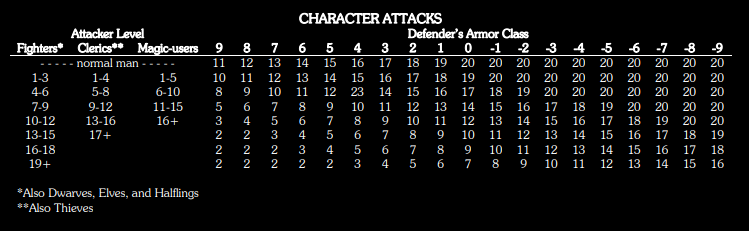
Lately I've been studying carefully this classic XP charts. 

I was thinking that as the thief progresses much faster than the fighter, he might actually get tougher than him at some point. I made the numbers and, using 1d4 and 1d8 HD respectivelly, the fighter will always tend to have more HP than the thief at the same XP, at around a 3:2 proportion. But that was it: The saves will always be equal or at +/- 1 difference. Same with the attack rate: the thief will attack worse at some levels, but will get higher levels faster so he will attack as good as the fighter during most of their career. So, essentially, the thief just sacrifices a potential 50% increase of HP and proficiency on some weapons and armor in exchange of the thief skills.


So, if that was the point, it seems unnecesarilly complicated: Writing their own XP chart, assigning a different HD size for each class... Would not be much easier to just say: "This is the universal XP chart for all classes. Fighters get 50% more HP, Thieves get thief skills"?

Well, maybe. Would it be better? again, maybe. Who knows.

The same could be said for the dwarf: In the end he is just the fighter but with MUCH better saves, a skill for discerning shit around dungeons and infravision. In exchange, he cannot use 2h weapons (irrelevant), but gets a small "tax" in  the shape of slightly increased XP requirements (a 10%). This also makes that, though they have the same d8 as fighters, their HP increases a 10% less in the same time on average. Wouldn't have been easier to trash the different chart altogether, alongside HD size differences, and just give the dwarves their pack (weapon restriction, infravision, saves, mining knowledge) and an increased amount of HP respectivelly to the thief standard? just a little bit smaller than the fighter one. Maybe just a bump to constitution: It makes sense in-game and would organically raise the dwarf's average HP.

Again, maybe. 

But the thing is that, even though I have made similar arrangements in my games, I actually like different PCs raising in level at different paces. It makes leveling up a special thing for everybody, just like a birthday party would not be the same if everybody in the world's birthday was the same day. It also feels natural for each race to have different XP milestones. It makes sense for the elf to level up very slowly! 


Still, I cannot help striving for minimalism and if the chance to supplant a chart with a procedure falls in my hands, I must at least consider it. I've had one idea to keep escalated progression amongst PCs while having the same chart for every class. More or less, it is like this:

Everytime you do something that might level you up (like, for example, retrieving 1000 gold pieces), you roll a die (lets say a d6) and sum that number to your XP

You level up at exponentially higher milestones. For example: 6 XP, then 16 XP,  them 40 XP, then 100. This way, you never know if this travel will get you leveled up until you actually bring back the gold or do whatever grants you that experience. Some characters will roll higher, some lower...

Once you have this, it is easy to have this system hacked to do other things: Some treasures or quests having you roll higher or lower dice: "this diamond was worth 1d8 XP. Killing that monster just 1d4". You can adjudicate some XP dice to a given "quest" without problem, with the chance of getting a single XP on a 1, or to get a big roll, which can even get you from level 1 to level 2 straight at the first downtime.

Also it can be used to balance races too: some races might be powerful, but they might have a penalty to leveling up and use 1d4 to do it. It can be the effect of an undead curse, or, converselly, be increased by the power of an item/magic/whatever. 

edit: see this alternate comparison of XP/HP on Spriggan's Den

Thursday, October 6, 2022

Fire Elixir Forever


I ran a long cyberpunk-themed campaign years ago, based on the adventures of a street gang (the PCs) versus another gangs of diverse levels; the most powerful one being a mix of the Yakuza and the OCP from Robocop. The rest of the setting was a wild mixture from Battle Angel Alita, Grand Thief Auto, The Warriors, Streets of Rage, Gungrave, Daredevil and Akira. The game stopped eventually due to two of my friends stopped talking to each other for unrelated reasons.
I used a very simple ruleset I came up with (Very similar to Lasers and Feelings, with "fiction first" style HPs and freeform skills) which had its pros and its cons, but it was very narrative and I didn't like it drove the game towards the players "negotiating" with the GM out of character; and made combats rely on my personal judgement and whims more than in tight rules. This made combats seem unfair on victories (it always felt like I had "given" them the combat) and even more unfair when they lost. I am maybe being so hard with myself: everyone involved were thrilled and we all remembet the campaign very fondly; pieces of it still appear on our day to day conversations and have changed the way we look at our hometown forever (the game was set on an alternate version of it)

Recently I "unwillingly" came up with some rules that I think that would have worked very good, and I want to write them here just in case I need them again. I don't think I will reunite the old gang or continue that campaign where we left it, but some of them are back in town and who knows if I can pull out some sort of spiritual "reboot".

Character Creation: Roll 4d6, then arrange them from highest to lowest. In that order they give you:

1) your age (add 11 to it. If your character is not part of a young gang for some reason, ignore this result)

2) # of starting items. You roll them on a separate table: some of them are actually traits and are inherent to you, while others are physical objects and can be given or traded to other PCs before the game starts.

3) Your starting hit points. Your gang's vest gives you an extra +1 as long as you wear it. 

4) Your # of skills

Skills: 


Kung-fu: This covers all melee or shuriken-based combat, from fists to katanas. 
Gun-fu: guns, guns, guns. I don't think the genre needs more differentiation in combat skills.
Ninjutsu: This is for when you dodge, sneak, jump more than one would thought, etc. It is possible for non-combatants to be skilled in this arts, specially for animals and kids.
Hacking: From John Connor stuff getting easy money to programming the Matrix
Mechanics: Engineering and repair of vehicles, cyberparts, the physical part of robots, etc.
Medicine: From first aid to acupunture to surgery to the implantation of cyberparts. Ido from GUNNM is an example of somebody who knows both medicine and mechanics
Driving: Useful for biker gangs who do a lot of road mayhem.
Charisma: This is not something that magically bends people to your will, but will come up when an NPC makes a reaction roll, when you try to influence a crowd or when you make a proposal to an NPC that is at least feasible to be accepted. This is Harry McDowell from Gungrave or Cyrus from the Warriors.

Notice that there are no void skills like cooking or lore: history. These nine are those that shape the genre I am trying to emulate. However I don't want to limitate the game to them. You can make up any skill you want as long as it doesnt step on the toes of all those listed above. Any kind of specific lore, an incredibly useless profession or hobby, etc. If you want optimization you can do it, if you want to be a flute player you can do it too. We had this rule for years, it worked perfecly and I loved it


Resolution:

You roll 1d6 if its something everyone can attempt. + 1d6 for skill; +1d6 for skill mastery, +1d6for situational bonus (This is called the Special die), up to 4d6

5-6 is a success. 4 is a partial success, and 1-3 is a failure

Combat:

Highest Hp goes first, unless duels and stuff where everyone rolls at the same time. 

You roll 1d6, + 1d6 for skill; +1d6 for skill mastery, +1d6for situational bonus (Special die), up to 4d6

The results are read like this:
1-3: miss
For each 4, you deal 1 damage.
For each 5 or 6, you deal 2 damage if using fists, 3 if using a street weapon and 4 if using a proper weapon.

Armor is rare, and normally pieces of combat cloth, such like a superhero's suit, provide some work as an extra amount of HP.
Real armor is more likely to happen when one has a metal exoskeleton, or a piece of cloth designed to stop a specific weapon (a kevlar vest for example). This kind of armor negates your best result when rolling against it, instead or in addition to HP increase.


Starting Items/Traits: not the definitive version, I am improvising it, but it looks something like this. There are also examples ingrained on how to deal with bonuses and mechanical parts on a system like this. Probably would benefit greatly from improving the table to a 1d36 one.

3 Minor Psychic Powers. Choose 1, the others may be granted to you sometimes at GM's discrection: Telekinesis, Psychometry, Telepathy, Clairvoyance. You can get better at this by investing in a secret skill: Eerieness.
4 1d6 grenades. They deal 1d6 damage on a hit. On a 4, you can but your enemy gets a free move against you. On a miss, you lose turn cant launch them yet.
5. Toolbox. Allows you to repair and custom vehicles, cyborgs and other stuff. Advanced surgery needs you to work in a lab (improve your homebase until you have one). 
6. Bionic implants, choose 1: Hacking Port (counts as a computer), Adamantium bones (+2 HP), Hidden street weapon; Bionic Eye capable of Thermal Vision. 
7. Aesthetic portable computer: Allows for hacking shit. Taking your effort to set multiple computers allows you to roll, and then re-roll the special dice that many number of times.
8. Tiger Kick: When using street or no weapons, you can add the situational die to combat rolls whenever you can use your legs. Once you miss a roll, your attack becomes predictable and you lose this bonus.
9. First Aid Kit. Use a turn & a medicine roll to cure 3 HP on a 5-6. On a 4, the kit is exhausted. On a miss, you also fail to heal anything.
10. Knife, Chain, Nunchucks or Spiked club (street weapons)
11. Apple, Chicken, Soda or Cigarettes. Those kind of shit gives you back 2 HP when consumed.
12. A couple of walkie-talkies
13. You get a light motorbike that allows for 2 passengers. Roll 1d6 to see its max speed (1:low, 6:very high)
14. Gun or Katana (mean weapons)
15. 1d6 doses of your favorite drug. Choose its effect: Hypnotic, Trippy, Stimulant, Chill, Knock-Out...
16. 1d6 Flashbombs and 1d6 shurikens.
17. Panzer Kunst. This martial art helps you to fight enemies twice as high as you or higher. Every time you score a 6 in melee combat, you can roll the "special" dice and add it.
18. Bionic Body specifically adapted to a single skill (+1 special dice per scene/combat)

Leveling up was achieved by surviving X game sessions, and every now and then you earned a new skill or improved an existing one. Now you also get +1 HP. We didn't use HP back then, but a status box (healthy - wounded - dead). In practice didn't work so good.


Lethality. The game is meant to be quite lethal for PCs once you start combating outside the "unarmed" range. You are expendable troops after all, but there are ways to cheat death. 0 or even -1 HP is just incapacitation/dying depending on what caused it; and can still be treated with a medicine kit or similar. But, if you have read enough Battle Angel Alita, you'll know that -2 HP characters that have their head or brain preserved can still come back if a good cyborg mechanic puts them on a new body.
You are also meant to improve your homebase through the game (specific rules to be written another day), and doing so allows you to have new characters start at level 2 or 3, which makes character death a little less painful.

Balance: I don't care shit about balance. You are a gang. All gangs have tough guys and weaklings, skilled and dumb members, who help each other. This is OK. If you get less skills or HP or shitty gear, you can still hang around and interact with the game world. You are not expected to get into mandatory mortal kombat, nor there are pre-planned solutions: attempt things that your character could do. Think how to buy, steal or borrow a solution. Ask NPCs to help you. Whatever. You are not meant to grind the whole setting. There is also a kind of balance in having toughest members fighting while the weak run or do their thing. Ajax and Swan make most of the beatings in The Warriors for a reason. Still, with time you may level up get better at something eventually.

Gameplay procedures: Will expand on this on another entry. I'm taking a lot of time to write this one and I am fucking eager to click publish, so I can chill and take my time with the rest. For now I'm proud with what I got.